The Pain Nobody Believed
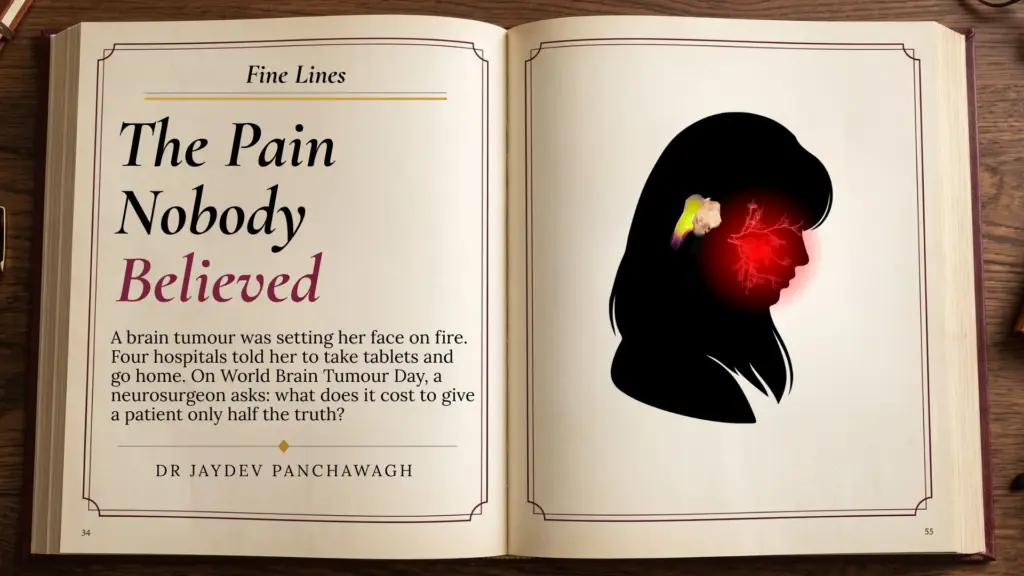
A brain tumour was setting her face on fire. Four hospitals told her to take tablets and go home. On World Brain Tumour Day, a neurosurgeon asks: what does it cost to give a patient only half the truth? She was in her early twenties. She came into the consultation room with her mother, holding herself very still — the careful stillness of someone who has learned that ordinary movement carries a price. She sat down without speaking. Her mother spoke for her. It had been like this for months. The pain had begun as an odd sensation, a warning that most young women would not recognise as anything sinister. Then it became electric. It arrived without notice, triggered by speaking, by eating, sometimes by a gust of wind across the cheek. By the time she came to Pune, it had made smiling impossible. Pain had taken that from her. Doctors have a name for this: trigeminal neuralgia. The trigeminal nerve begins at the base of the brain and fans out across the face in three branches — towards the eye, the cheek, the jaw. When something disturbs it at its root, the result is stabbing, burning, electric-shock pain across whichever branch is involved. It has been called, with reason, the suicide disease — not for melodrama, but because uncontrolled pain sustained over months and years strips people of the will to continue. I am careful with that label. But it tells you something precise about what this young woman was living through. Pain had erased smiling from her face. That is not a figure of speech. That is a clinical fact. She had been to four hospitals before she came to us. At each one she had been given medication — carbamazepine, the standard first treatment for trigeminal neuralgia, an anti-seizure drug that dampens the nerve’s electrical activity. It does not treat the cause. And it carries a cost: drowsiness, forgetfulness, a fog that settles over the day. She was functioning at the edge of what was bearable — medicated into dullness on one side, tormented by pain on the other. But here is the question nobody had stopped to ask. Why is a woman in her early twenties developing trigeminal neuralgia? This is a condition far more common in people over fifty — its incidence peaks between fifty-two and fifty-eight. When it appears in a younger patient, the medical literature is unambiguous: look for a structural cause. An MRI is not optional. Because in patients this age, there is very often something visible behind the pain. Her MRI showed it clearly. A tumour in the cerebellopontine angle — a narrow, critical corridor at the base of the skull where the brainstem sits close to the inner ear and several cranial nerves converge. Cerebellopontine angle tumours — meningiomas, schwannomas, epidermoids — account for six to ten per cent of all intracranial tumours. They are not rare. And when they cause trigeminal neuralgia in a young patient, they are among the most treatable conditions in neurosurgery, in the right hands. This one was pressing directly on the trigeminal nerve at its root entry zone — the most sensitive point, where the nerve meets the brainstem. It was also pressing on the facial nerve and the vagus nerve. It was not cancer. Benign — slow-growing, non-invasive in the way cancers are invasive. But benign does not mean harmless. Benign does not mean harmless. A slow tumour in the wrong place is still a tumour with a plan. A benign tumour in this location grows quietly and steadily, and as it does, it takes more of the surrounding structures with it. Left untreated over years, it would have threatened her brainstem. At that stage, surgery becomes considerably harder. The window she had — a tumour still at a size and position where a clean result was achievable — was not permanent. She had been told at multiple centres that surgery was possible but extremely risky. The risks named were real: facial nerve damage, hearing loss, incomplete pain relief. The cerebellopontine angle sits beside structures governing the face, balance, and hearing. These are genuine concerns. The surgeon who operates here must know this anatomy not as a diagram but as a lived familiarity — the slight variation in how each structure presents, how it behaves under the microscope, what it tolerates. But here is where the conversation had gone wrong for her. Risk was named. Risk was not contextualised. Nobody had placed alongside it an honest account of the alternative — what happens if she continues on carbamazepine for the next five years while the tumour quietly enlarges. What is the risk of inaction? In medicine, we have a habit of presenting surgical risk in isolation, as though the other choice — doing nothing — carries no risk at all. It always does. When she came to us, I told her the risks — I do this first, before anything else. But I told her something else as well. Risk in surgery is not a fixed number. It shifts depending on where the surgery is done, who is operating, what equipment is available, and how many times that surgeon has been in this exact anatomical territory before. The cerebellopontine angle is not a place for occasional visits. Risk in surgery is not a fixed number. It is shaped by who holds the instruments — and how many times they have been here before. She had done her research. She had found that our team had operated on a significant number of cerebellopontine angle tumours over more than two decades. She came with her mother, a folder of imaging neatly organised, and a list of written questions. I have met this kind of patient before. They are among the most clear-headed people who walk through a neurosurgical consultation — afraid and entirely rational at the same time. We operated. The tumour was removed through a retrosigmoid approach — a keyhole route behind the
