When the Spine Speaks
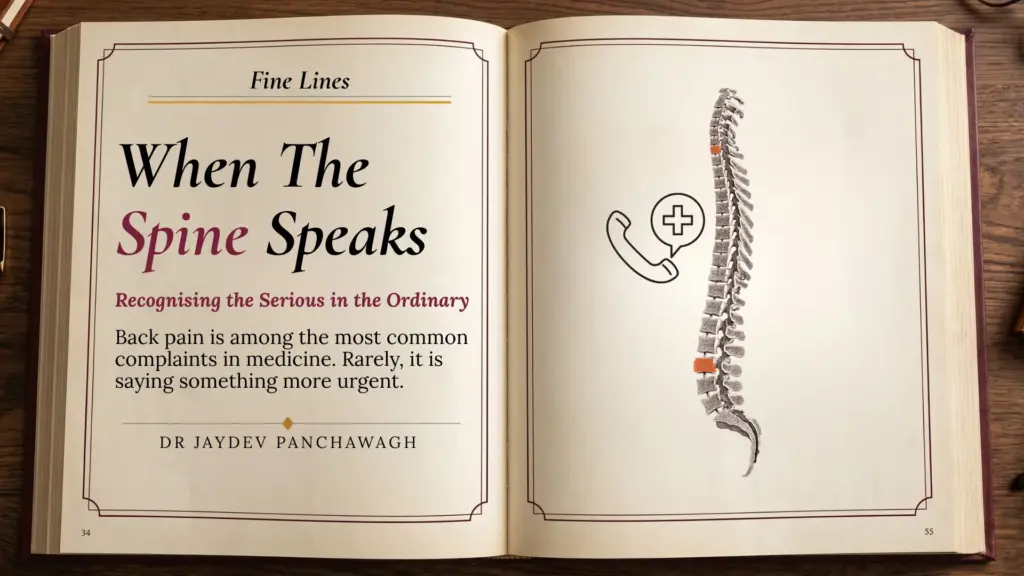
“Most back pain is harmless, and most of the time dismissing it is the right call. But certain patterns — pain that wakes you at night, pain after a fall, pain that travels down a limb — mean something different. This essay is about learning to recognise those patterns before it is too late.” — Dr Jaydev Panchawagh · Neurosurgeon, Pune The Complaint Back Pain, Neck Pain, and Sciatica: Why ‘Common’ Does Not Always Mean ‘Safe’ The ache that visits nine in ten of us — and the one that stays In our sedentary, screen-bound age, back pain has become an almost universal complaint. Nine in ten of us will know low back pain or neck pain at some point — some passingly, some intimately. The software engineer hunched fourteen hours over a laptop. The homemaker on her feet from dawn to dusk. The commuter jolting over rutted roads on a two-wheeler. The farmer bent low over the earth. Spinal pain spares no occupation and no class. And precisely because it is so common, it is so often dismissed. A little balm. A tablet. It will pass. This is the quiet danger. Most back pain is indeed harmless — a transient protest from overworked muscle. But occasionally, hidden inside that ordinary ache, there is something else: a slipped disc, a pinched nerve, an infection, sometimes a tumour. Many patients arrive at the neurosurgical clinic late, sometimes too late, because what announced itself as inconvenience proved, in the end, to be disease. To know the difference matters. The Ordinary Ache What Is Mechanical Back Pain? Causes, Symptoms, and How It Resolves When the spine protests, but does not warn Let us begin with the kind of back pain that is exactly what it seems. You played a hard game of cricket on Sunday. You hauled a refrigerator up three flights of stairs. You bent awkwardly to lift a child, sat through a long meeting in a poorly designed chair, or skipped your warm-up before the morning run. The paraspinal muscles and ligaments — the soft-tissue scaffolding of the spine — are strained. A ligament tightens. A muscle goes into spasm. Local inflammation follows, and pain registers. This is what physicians call mechanical or non-specific back pain, and it accounts for the vast majority of cases. This kind of pain has a familiar arc. It is worst on the first day or two. It softens with rest. A warm-water bag pressed against the small of the back brings disproportionate relief; heat increases local blood flow, relaxes muscle fibres, and eases the cramp. A short course of simple analgesics — paracetamol, occasionally a non-steroidal anti-inflammatory — taken under medical advice, usually suffices. A scientifically guided massage and gentle core-strengthening exercises help. Within a week, sometimes less, the pain resolves. This is not the back pain that should worry you. The Warning Signs Red Flags in Back Pain: Warning Signs That Need a Spine Specialist Pain after injury, night pain, fever, weight loss — and why each one matters The trouble begins when the pain carries with it certain warning signs — what physicians call red flags. These are early indicators of more serious spinal pathology: fracture, infection, malignancy, or nerve compression. To recognise them is to gain time. And in spinal disease, time often determines outcome. The first red flag is pain that follows trauma. A fall from a height. A road accident. A direct blow to the spine. If the pain does not subside but grows steadily worse, it must not be ignored. Vertebral compression fractures can be subtle, sometimes undetectable on clinical examination alone, and only imaging — an X-ray or MRI of the spine — reveals them. The second is pain that wakes the patient at night. Ordinary mechanical back pain eases when you lie down; the spine, unloaded, is relieved. But there is another kind of pain — deeper, persistent, unaffected by posture — that disrupts sleep and is not relieved by rest. This pattern is characteristic of inflammatory disease, spinal infection, or a spinal tumour. The third is fever accompanying back pain. Together they often indicate infection — tuberculosis of the spine, or Pott’s disease, still very much present in this country, or pyogenic discitis and vertebral osteomyelitis. The combination is rarely coincidence. Then there is unintended weight loss accompanying the ache. The body does not surrender kilograms without reason. When the scale falls while the back complains, the two facts must be considered together; underlying malignancy, including spinal metastasis from breast, lung, prostate, or other primary cancers, is among the possibilities. And finally, history matters. A prior cancer, even one believed cured. Osteoporosis. Age beyond fifty. In such patients, the simplest-seeming back pain warrants medical attention. Osteoporotic vertebrae can fracture from a sneeze, a sudden turn, the lifting of a grandchild. A diagnosis arrived at this way is not a sentence. It is a map. It tells you and your physician where you are, and what paths lie ahead. The Nervous System Sciatica, Slipped Disc, and Cervical Spondylosis: When Back Pain Radiates Down the Arm or Leg Radiculopathy, cauda equina syndrome, and the symptoms that cannot wait There is another category of warning — subtler, and often more consequential — that arises from the nervous system itself. The spine is not merely a column of bone. Threading through its central canal is the spinal cord, and at each vertebral level a pair of nerve roots emerges through the intervertebral foramina to supply the limbs and trunk. When a disc herniates — a slipped disc, or disc prolapse — or when degenerative change such as cervical spondylosis or lumbar spondylosis narrows the bony channels through which these nerves pass, pressure develops on neural tissue. This narrowing, when severe, is called spinal stenosis. And pressure on a nerve does not stay local. It produces symptoms along the nerve’s distribution — what clinicians term radiculopathy. So we listen for symptoms that travel. Pain that begins in the neck and radiates down the arm —
The Tumour That Stole His Steps
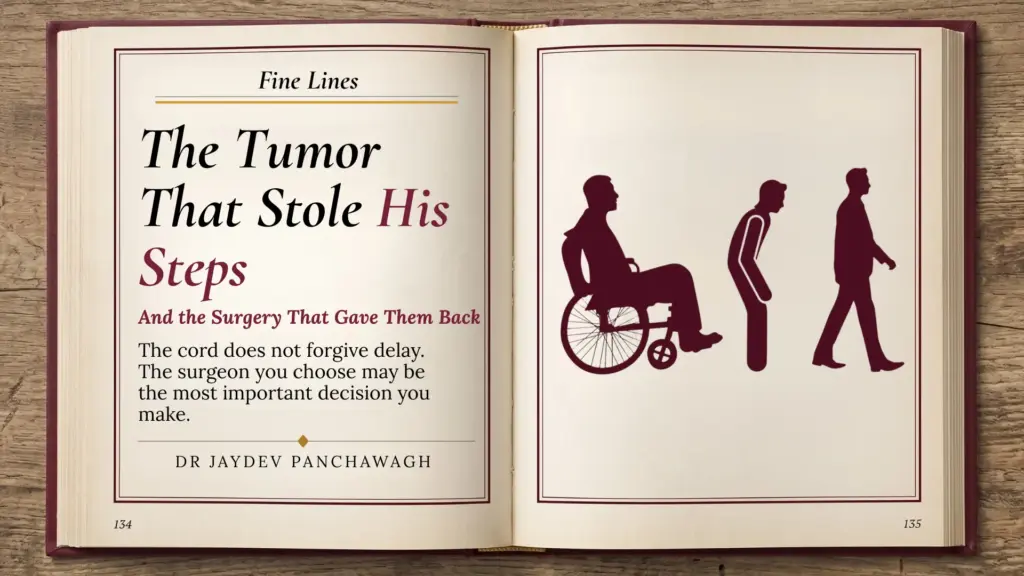
The cord does not forgive delay. The surgeon you choose may be the most important decision you make. Some patients enter a clinic and the diagnosis is already written on how they move. Mr. Pradeep was forty-four years old when he first noticed something was wrong. A civil contractor, accustomed to long days on construction sites and longer evenings on his feet, he dismissed the ache between his shoulder blades as the price of a physical life. His legs, he told himself, were tired. The stumble on a flat surface — that was nothing. The heaviness in his thighs — that was age, or overwork, or both. But the body does not lie indefinitely. Over the following weeks, the heaviness became weakness. The weakness became unreliability. And one morning, six months later, Mr. Pradeep could not rise from his bed without his wife’s help. He arrived in a wheelchair, pushed by a son who looked more frightened than his father. The Anatomy What Was Growing Inside How a spinal cord tumour announces itself — and why we so often miss what it is saying The spinal cord is among the most precisely constructed structures in the human body. Roughly the diameter of your little finger, it carries the entire conversation between the brain and the body — every instruction to move a limb, every signal of touch or pain returning upward, every unconscious command that keeps the bladder and bowel functioning. It does all of this through a canal of bone and membrane that offers almost no room for anything else. When a spinal cord tumour begins to grow inside that canal, it has nowhere to go except inward — against the cord itself. It encroaches slowly, over months. The cord compensates for as long as it can. And so the early symptoms of spinal cord compression appear in disguise: a dull ache in the back, fatigue in the legs, a faint tingling that comes and goes. These are the kinds of complaints that bring a patient to a general physician, not a neurosurgeon. They suggest a disc problem, or overwork, or the creeping discomfort of middle age. This is the particular cruelty of a spinal cord tumour. It announces itself early, in a language that is easily mistaken for something ordinary. By the time the weakness becomes unmistakeable — by the time the stumble becomes a fall, and the fall becomes an inability to stand — the cord has often been under sustained compression for months. The window for full recovery is not closed, but it is no longer wide open. The Diagnosis The MRI and What It Told Us A tumour outside the cord but inside the envelope that protects it — and why that distinction changes everything Mr. Pradeep’s MRI was unambiguous. There was a well-defined mass inside his spinal canal, at the thoracic level — the mid-back — sitting outside the spinal cord itself but pressing relentlessly against it. The cord was visibly displaced to one side. The soft tissue planes around it had been obliterated. This was an intradural extramedullary spinal tumour: it lay within the dural sac — the waterproof membrane enclosing the cord and its surrounding fluid — but outside the cord’s own substance. This distinction matters enormously in determining both the surgical approach and what recovery is possible. A tumour that has infiltrated the cord carries a different prognosis from one that merely presses against it from outside. The most common tumours in this category are schwannomas — arising from the Schwann cells that wrap the spinal nerve roots — and meningiomas, which grow from the meningeal lining. The majority are benign. The spinal cord tumour colonising Mr. Pradeep’s thoracic canal had stolen his ability to walk. But it had not yet stolen the cord’s capacity to recover. That window was still open — barely, but open. The Decision The Son’s Homework How a young engineer with a folder of MRI scans quietly made the most important decision of his father’s recovery Mr. Pradeep’s son — a young engineer in his late twenties, methodical by temperament — spent two weeks after the MRI making phone calls. He went first to the nearest large hospital. They could operate, they said, but the surgeon had limited familiarity with intradural spinal cord tumours specifically. He called a second centre, two hours away. They were willing — but they lacked dedicated intraoperative neurophysiological monitoring, the real-time signals from the nervous system that tell a surgeon, during the operation itself, whether the cord is being stressed. He then spoke to a physiotherapist who had observed outcomes across multiple centres. The advice was simple: for a tumour on the spinal cord, find the surgeon who has done the most of them. The hospital’s location matters far less than what happens inside the operating theatre. The son made a longer journey. He could have flown in under an hour. He chose instead to drive, arriving with his father in the wheelchair, a carefully organised folder of imaging, and a list of questions written in the margins of a notebook. I have met this kind of family before. They ask the right questions — not how soon, but how often; not how convenient, but how experienced. They understand, with the clear-eyed logic of someone who has done the research, that spinal cord surgery is not a procedure where goodwill substitutes for deep familiarity. The operating microscope — without which this surgery should not be attempted — transforms the operative field in ways that take years to learn to navigate. The ability to find and follow the exact plane between a schwannoma and the compressed cord beneath it, in a space no wider than a thumbnail, is knowledge that accumulates over a long career, not a short one. The son will probably never fully appreciate how consequential that drive was. But the cord knew. The Operation Inside the Operating Theatre Total resection of a spinal cord tumour — precision measured
