I have spent much of my working life looking directly at the brain. Under the microscope it does not look like a mind. It is a tissue — pale, glistening, threaded with vessels and neurons finer than hair. Somewhere in that tissue lives everything a person is: their memory, their grief, their capacity for joy, their creativity, their essence!.
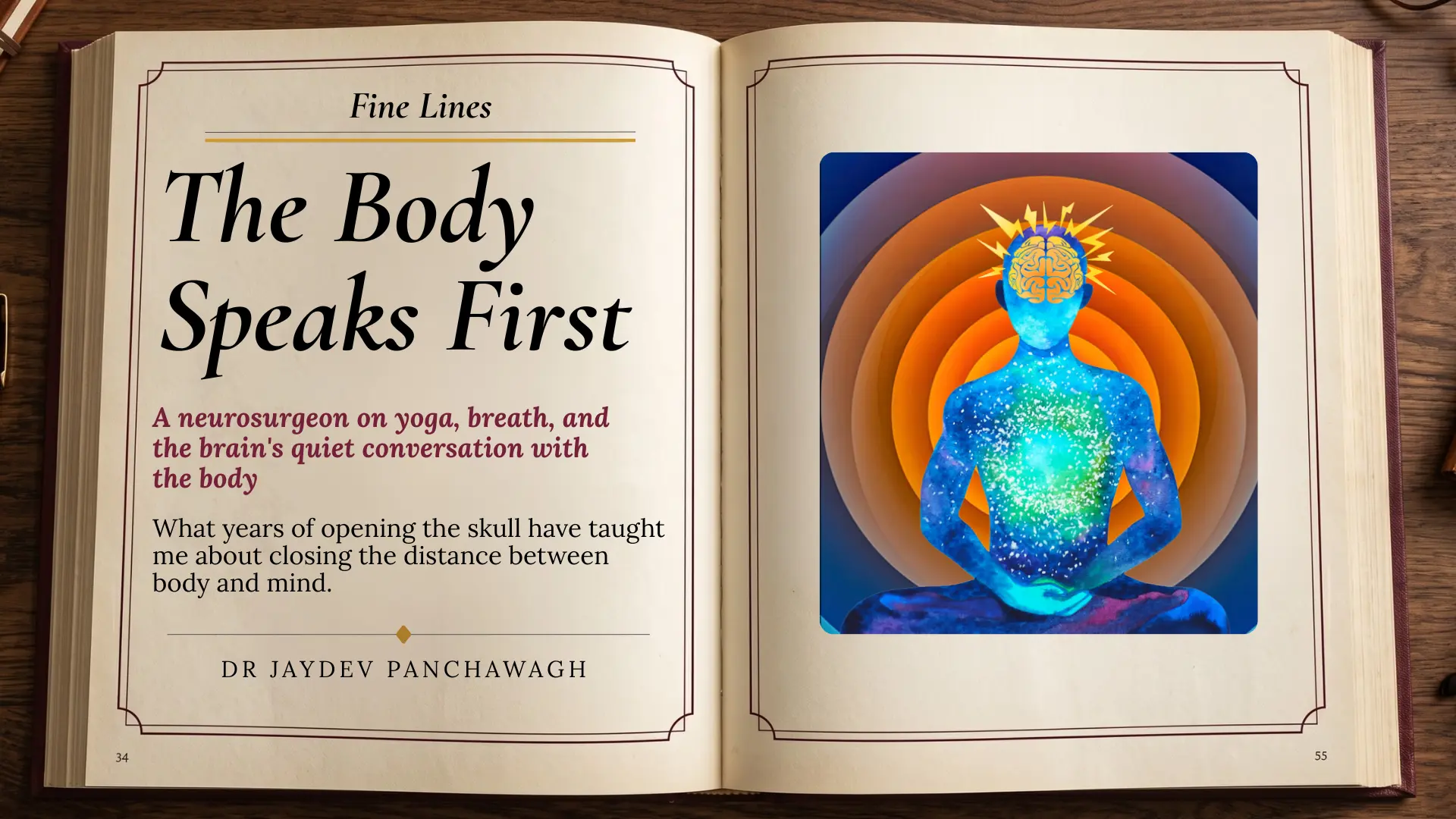
The person who walks into my clinic and the organ that I look at later are the same. One is integrated into the other, yet somehow, sometimes feel different. This gap, between the felt self and the physical organ, is where yoga, exercise, and breath do their quiet work. It is also where a great deal of modern brain health research now lives.
What Neurosurgery Teaches About the Mind
The brain is responsive.
Neurosurgery teaches humility about this gap. I have operated on brains that looked structurally identical under the microscope and yet belonged to people living entirely different inner lives. Anatomy alone does not explain temperament, resilience, or despair. Somewhere between the wiring and the person, physiology and psychology cross paths continuously, invisibly, all day.
This is not new knowledge. In fact, it is as old as the ancient scriptures, and perhaps older. Long before imaging could show a hippocampus changing shape or a vagus nerve firing, the Yogis had already worked out, through daily observation and discipline, that the body was never separate from the mind. Modern neuroscience has mostly caught up to confirm what they intuited centuries ago.
The Two-Way Street: Psychosomatic and Somatopsychic
The mind moves the body. The body moves the mind back.
Most of our actions-conscious and subconscious are psychosomatic: the mind acts and controls the body. Anxiety tightens the chest. Grief exhausts the limbs. Chronic stress raises cortisol (the stress hormone) and, over years, changes how the brain itself is built. This direction is well accepted, well studied, rarely questioned.
The reverse direction, somatopsychic, is spoken about less, though it is equally real. The body also acts on the mind. A stiff, sedentary body tends to carry a duller mood. A body that moves regularly — through yoga, walking, swimming, any sustained activity — tends to carry a steadier one.
Body and mind are not two systems talking to each other. They are one system, described in two languages.
The nervous system does not read this as metaphor. Movement changes blood flow to the brain, alters circulating hormone levels, and adjusts the tone of the vagus nerve — the long, wandering nerve that links gut, heart, lungs, and brain in constant two-way conversation.
Yoga, Exercise, and the Ageing Brain
Time asks a question of every brain. Movement is the honest answer.
Every year, research adds to a fairly consistent finding: people who stay physically active in midlife and beyond tend to show better preservation of brain volume, particularly in the hippocampus, the structure most involved in memory. Regular aerobic activity is associated with higher circulating levels of a protein called brain-derived neurotrophic factor, or BDNF, which supports the survival and growth of neurons. Regular practice is also linked to neuroplasticity — the brain’s ability to keep forming new connections, not only in childhood but across life.
Several large population studies suggest that sustained physical activity, including yoga-based movement, is associated with a lower risk of cognitive decline and dementia in later life. I want to be careful here: Association is not proof of prevention. No form of exercise, yoga included, guarantees protection against dementia. What the evidence honestly supports is a lower risk, and better quality of life.
Breath as the Body's Oldest Medicine
Of all the involuntary things the body does, breath alone will let you hold the wheel.
Breathing is unusual among bodily functions. The heart cannot be consciously slowed by an act of will. Digestion cannot be willed faster. But breath sits right at the border of voluntary and involuntary, and yogic tradition discovered this border early and built an entire discipline around it.
Slow, controlled breathing activates the vagus nerve and shifts the body toward its parasympathetic state — the rest-and-repair mode — lowering heart rate and easing the release of stress hormones. This is measurable now, in heart rate variability studies and in functional imaging. Pranayama is not mysticism dressed up in the language of science. It is a very old technique for doing something neuroscience can now describe with some precision: using breath as a handle on the nervous system.
Happy Hormones
Movement does not cure sadness. It encourages happiness.
Exercise raises endorphins, serotonin, and dopamine — the chemistry loosely called the happy hormones. Regular physical activity is consistently associated with lower rates of depression and anxiety, and is increasingly used as a genuine adjunct in their treatment, alongside therapy and medication, never as a replacement for either.
Movement helps. It is not a cure. But as an adjunct, sustained gently over months and years, its effect on mood is one of the better-supported findings in psychiatric research.
A Closing Thought
Today we have machines that reach into the nervous system to calm or train a mind that will not calm itself or move the body. We are proud of these machines, and we should be.
I did not train as a philosopher, only as a surgeon who has spent enough hours inside the skull to develop a certain respect for what lies outside it. The breath is a great healer. It needs no machine. No appointment. No wires. It asks only to be practised, regularly and consistently.
That is the real inheritance of the old yogis. Not a cure. Not a substitute for medicine when medicine is truly needed. Just a tool, free to almost everyone, for the ordinary days and the hard ones. The body and the mind have always known how to speak to each other. We are only now learning to listen properly.
Breathe. Observe. Move. Transform yourself.