Inferno on the Face
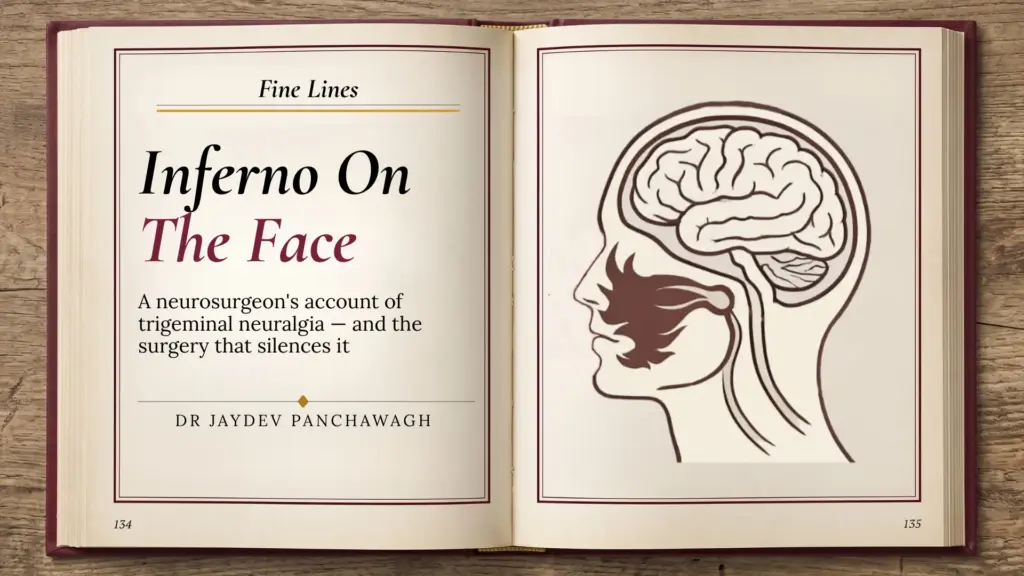
A neurosurgeon’s account of trigeminal neuralgia — the pain that has no mercy — and the surgery that can silences it permanently “Many neurologists consider it among the most severe pains the human nervous system can generate.Some have called it the suicide disease — not as metaphor,but because untreated cases carry a real risk of pushing patients toward self-harm.” — Dr Jaydev Panchawagh · Trigeminal Neuralgia Centre, Pune While operating on a patient with the extreme pain of trigeminal neuralgia, I turned the beam of the neuromicroscope deep into the lower part of the brain — onto the very structure called the pons. Under that cold, brilliant light, the trigeminal nerve came into view. The fifth cranial nerve. The great sensory highway of the face. Her trigeminal nerve was not the smooth, pearl-white cord it was supposed to be. It had been crushed flat. A blood vessel — large, unyielding, pulsing — had buried itself into the nerve’s most vulnerable segment: the root entry zone, where the protective myelin sheath is thinnest. The vessel had not merely rested against the nerve. Over the years, it had bored into it, and the nerve had frayed apart in response — its fibres separating like threads pulled from a torn cloth. Seventy-five to eighty times a minute, the artery pulsed. With each beat, a blow of a hammer on the nerve. For years. Day after day, month after month, year after year. The nerve looked like a crushed ribbon. “This degree of damage need not have happened. If surgery had been performed earlier, this patient would not have suffered so long.” The delay, in case after case, has the same cause: the patient simply did not know. The family did not know. Often enough, even the treating doctors did not know. Trigeminal neuralgia has spent too long entangled in a web of misunderstanding. Nivedita Bhatnagar: An Architect Without Words Nivedita Bhatnagar (name changed) — an architect from Delhi. Deeply capable. Perceptive. And extraordinarily eloquent about her own pain. When she first came to our centre, she could only gesture. Even the small act of opening her mouth to form words triggered a bolt of electricity through the right side of her face. The simple daily architecture of language had become a minefield. “It truly began in January 2004. A sudden, sharp pain would start in the upper right gum and radiate into the right cheek. The pain was like an electric shock. Instant. Without warning. Brushing my teeth, if the brush touched the right gum — or while chewing on that side — these were enough to trigger it. An unbearable, shattering jolt.” She went first to a dentist, as almost every patient with this condition does. The upper right molar received a root canal. The pain not only persisted — it grew. A neurologist recognised a nerve problem and prescribed carbamazepine. “The medicine helped while it worked. But it made me drowsy. I began forgetting things. As the dose increased, I started losing my balance when I walked. I thought: if one nerve in one small location is the problem, why am I numbing every nerve in my body? That is not treatment. That is suppression.” She was exactly right. The drugs do not address the cause. They address the signal. And as the underlying compression worsens, the signal grows louder, the dose must rise, and the side effects multiply. The person diminishes. The Architecture of Fear It is not the pain alone that destroys a life — it is the anticipation of pain. Between attacks, the person lives in a state of suspended dread. Will it happen now? This question follows every meal, every conversation, every walk in the wind. The face becomes a danger zone. People stop speaking in full sentences, stop eating certain foods, stop going outside in cold weather, stop socialising. Sustained pain remaps the brain. It alters threat perception, attention, sleep, and mood. A person with long-standing trigeminal neuralgia has not only a damaged nerve — they have a nervous system that has been reorganised by years of crisis. What Is Trigeminal Neuralgia — The Science The trigeminal nerve is the fifth and largest of the twelve cranial nerves, with three branches covering the forehead and eye, the cheek and upper jaw, and the lower jaw and chin. In trigeminal neuralgia, something goes wrong at precisely the point where the nerve enters the pons. An adjacent blood vessel — most often the superior cerebellar artery — subjects the nerve to constant mechanical pressure. As we age, arteries lengthen and grow more tortuous. A vessel that once ran parallel to the nerve begins to loop toward it. It makes contact. It presses. It pulses — seventy, eighty, a hundred times a minute. Over years, this pulsatile trauma erodes the myelin sheath. When the myelin is gone, bare axons are exposed. The trigeminal nerve begins to misfire in response to the lightest stimuli: a brushstroke, a breath of cool air, a sip of water. “Some have called it the suicide disease — not as metaphor, but because untreated cases carry a real risk of pushing patients toward self-harm. The pain is that severe and that relentless.” The Inadequacy of Burning the Nerve For most of the last century, treatments have been aimed at the nerve itself — not the offending vessel. Alcohol injections. Radiofrequency ablation. Glycerol injections. Stereotactic radiosurgery. But this logic misses the point entirely. The nerve is not malfunctioning because it is inherently defective. It is malfunctioning because it is being compressed. Ablating the nerve addresses the symptom while leaving the cause in place. As the vessel continues to press, the disease continues to advance. Each repetition carries risks — including permanent facial numbness, or the development of anesthesia dolorosa, in which the face is numb but burning simultaneously. Peter Jannetta and the Surgery That Changes Everything In the 1960s, an American neurosurgeon named Peter Jannetta changed the course of this disease permanently. His premise was
A Crooked Smile
A neurosurgeon’s account of the disorder that steals the face — and the surgery that gives it back “This condition does not kill. It does not blind. It leaves no visible scar.And yet — in a career spent operating inside the human nervous system —it ranks among the cruelest disorders I have encountered.” — Dr Jaydev Panchawagh · MVD Surgery Centre, Pune This neurological condition does not kill. It does not blind. It leaves no visible scar. And yet, in the quiet devastation it delivers to ordinary life, it ranks among the cruelest disorders I have encountered in a career spent operating inside the human nervous system. It is called Hemifacial Spasm — HFS, in the shorthand of neurology. In Marathi, lacking a precise equivalent, I once named it myself in an article. The disease of the winking eye. Or simply, the winking disorder. The name stuck. It fits, with uncomfortable accuracy. Over the past twenty years, practising out of Pune — the hub of education and culture in India — we have dedicated ourselves to this particular corner of neurosurgery: Microvascular Decompression, or MVD. In that time, I have met hundreds of patients carrying this condition. I have watched it shrink lives. I have watched it end marriages, cost jobs, and confine spirited human beings to the narrow shelter of their own homes. And I have, thankfully, watched surgery set most of them free. This is what I want to write about. Not the disease alone — but the disturbing stories it produces. The misunderstanding that surrounds it. And most importantly, the treatment that exists but remains, bewilderingly, unknown to most who actually need it. What Exactly Happens Picture the face of someone you know. Now imagine that, without warning or invitation, one side of that face begins to move on its own — in twitches, in spasms. It begins small. A flutter near the eye. A twitch of the eyelid — the kind every tired person has felt at the end of a long day. Easy to dismiss. Easy to wait out. But in hemifacial spasm, the waiting changes nothing. The flutter does not subside. It returns. It returns more often. It becomes a wink. Over months and years, the spasm migrates southward along the face. The cheek joins the eye. Then the corner of the mouth. One entire side of the face begins to contract — repeatedly, involuntarily, without notice — and always, with grotesque timing, at the worst possible moments: at the bank counter, in the classroom, at the reception desk, across the dinner table. “The affected person appears to be winking deliberately. In reality, they have no more control over that wink than over the beating of their heart.” Stories That Refuse to Leave Sandeep was in his mid-thirties when he came to our clinic in Pune, his wife Swati beside him. He held his right hand cupped against the right side of his face — a gesture I have seen so many times now that I recognise it before the patient even sits down. It is the posture of someone trying to hide themselves from the world. Swati told me what had happened the previous week. Sandeep had been standing at a bus stop in Mumbai, reading a magazine. The woman to his right turned on him suddenly. She was furious. She said: “Aren’t you ashamed? Winking like that? Do it again and I will call the police.” Before he could explain, two bystanders had struck him. This happened. It is not embellished. I write it as it was told to me, by the man who lived it. “If only I had known this could be cured. If only someone had told me. The years I lost.” Voices from Across India — and the World From Chennai: a young woman who worked at the reception desk of a prominent company. At thirty-two, spasms arrived. She lost the job she had built her career around. From Jharkhand: a young man whose marriage proposals kept dissolving. From Mumbai: a man whose marriage ended. From Kerala: a sixty-five-year-old who had not slept soundly in years. From Africa: a young man who told me, with a quiet sadness I still remember, that no woman on any bus would sit across from him. The Architecture of the Problem The facial nerve — the seventh cranial nerve — governs every muscle of expression. Smile, frown, blink, squint: all of it moves on this nerve’s command. Near its origin at the brainstem, there is a brief stretch where its protective myelin sheath changes character — from central myelin to peripheral myelin. The Root Exit Zone — Where Vulnerability Lives Think of the stitching at the cuff of a shirt sleeve. Usually seamless. But occasionally, the myelin sheath of some facial nerves is not stitched properly at this delicate transition zone — the Root Exit Zone. There are gaps. Potential vulnerabilities, waiting. A blood vessel comes to rest against this vulnerable segment and pulsates with each heartbeat. Tap, tap, tap. Thousands of times a day. In neurosurgical language: a neurovascular conflict. Over time, the friction erodes the myelin — the nerve’s electrical insulation. When insulation fails, signals short-circuit. The facial muscles start receiving signals they were never sent. They contract. They spasm. The face begins its involuntary performance. The Surgery That Cures There is one and only one treatment that addresses the cause of hemifacial spasm rather than its symptoms: Microvascular Decompression — MVD. Through a small opening behind the ear, the neurosurgeon places a small pad of Teflon between artery and nerve. The mechanical irritation ends. The myelin regenerates. The spasms stop. “We are what we repeatedly do. Excellence, then, is not an act, but a habit.” — Aristotle Our Results — MVD Surgery Centre, Pune Our centre, established in 2004, has performed more than 775 MVD operations. Results presented at national and international conferences from 2014 through 2025. Failure rate: one percent. Complications declining steadily with accumulated experience. An
