This neurological condition does not kill. It does not blind. It leaves no visible scar. And yet, in the quiet devastation it delivers to ordinary life, it ranks among the cruelest disorders I have encountered in a career spent operating inside the human nervous system.
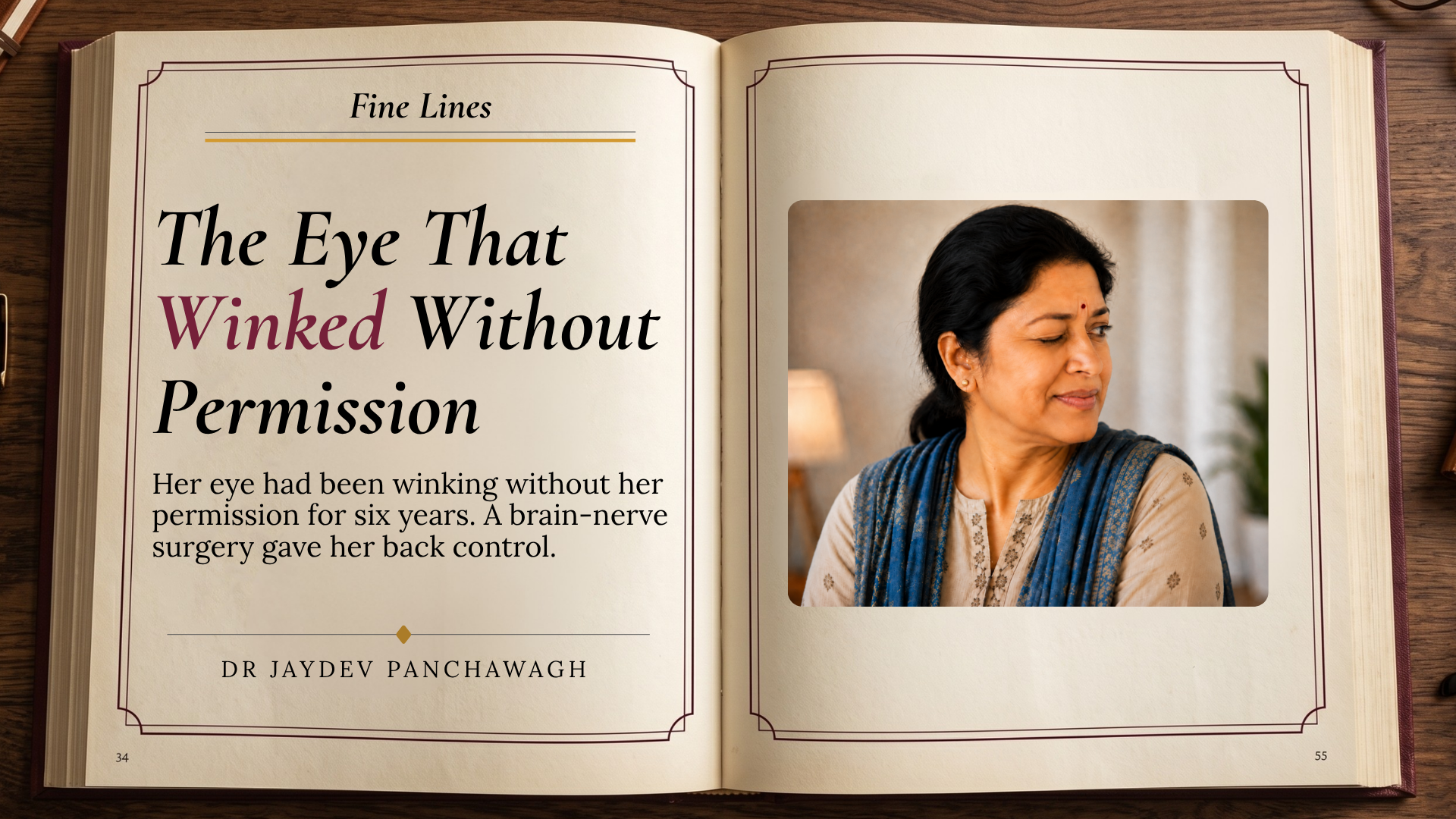
It is called Hemifacial Spasm — HFS, in the shorthand of neurology. In Marathi, lacking a precise equivalent, I once named it myself in an article. The disease of the winking eye. Or simply, the winking disorder. The name stuck. It fits, with uncomfortable accuracy.
Over the past twenty years, practising out of Pune — the hub of education and culture in India — we have dedicated ourselves to this particular corner of neurosurgery: Microvascular Decompression, or MVD. In that time, I have met hundreds of patients carrying this condition. I have watched it shrink lives. I have watched it end marriages, cost jobs, and confine spirited human beings to the narrow shelter of their own homes. And I have, thankfully, watched surgery set most of them free.
This is what I want to write about. Not the disease alone — but the disturbing stories it produces. The misunderstanding that surrounds it. And most importantly, the treatment that exists but remains, bewilderingly, unknown to most who actually need it.
What Exactly Happens
Picture the face of someone you know. Now imagine that, without warning or invitation, one side of that face begins to move on its own — in twitches, in spasms.
It begins small. A flutter near the eye. A twitch of the eyelid — the kind every tired person has felt at the end of a long day. Easy to dismiss. Easy to wait out. But in hemifacial spasm, the waiting changes nothing. The flutter does not subside. It returns. It returns more often. It becomes a wink.
Over months and years, the spasm migrates southward along the face. The cheek joins the eye. Then the corner of the mouth. One entire side of the face begins to contract — repeatedly, involuntarily, without notice — and always, with grotesque timing, at the worst possible moments: at the bank counter, in the classroom, at the reception desk, across the dinner table.
“The affected person appears to be winking deliberately. In reality, they have no more control over that wink than over the beating of their heart.”
Stories That Refuse to Leave
Sandeep was in his mid-thirties when he came to our clinic in Pune, his wife Swati beside him. He held his right hand cupped against the right side of his face — a gesture I have seen so many times now that I recognise it before the patient even sits down. It is the posture of someone trying to hide themselves from the world.
Swati told me what had happened the previous week. Sandeep had been standing at a bus stop in Mumbai, reading a magazine. The woman to his right turned on him suddenly. She was furious. She said: “Aren’t you ashamed? Winking like that? Do it again and I will call the police.” Before he could explain, two bystanders had struck him.
This happened. It is not embellished. I write it as it was told to me, by the man who lived it.
“If only I had known this could be cured. If only someone had told me. The years I lost.”
Voices from Across India — and the World
From Chennai: a young woman who worked at the reception desk of a prominent company. At thirty-two, spasms arrived. She lost the job she had built her career around.
From Jharkhand: a young man whose marriage proposals kept dissolving. From Mumbai: a man whose marriage ended. From Kerala: a sixty-five-year-old who had not slept soundly in years. From Africa: a young man who told me, with a quiet sadness I still remember, that no woman on any bus would sit across from him.
The Architecture of the Problem
The facial nerve — the seventh cranial nerve — governs every muscle of expression. Smile, frown, blink, squint: all of it moves on this nerve’s command. Near its origin at the brainstem, there is a brief stretch where its protective myelin sheath changes character — from central myelin to peripheral myelin.
The Root Exit Zone — Where Vulnerability Lives
Think of the stitching at the cuff of a shirt sleeve. Usually seamless. But occasionally, the myelin sheath of some facial nerves is not stitched properly at this delicate transition zone — the Root Exit Zone. There are gaps. Potential vulnerabilities, waiting.
A blood vessel comes to rest against this vulnerable segment and pulsates with each heartbeat. Tap, tap, tap. Thousands of times a day. In neurosurgical language: a neurovascular conflict.
Over time, the friction erodes the myelin — the nerve’s electrical insulation. When insulation fails, signals short-circuit. The facial muscles start receiving signals they were never sent. They contract. They spasm. The face begins its involuntary performance.
The Surgery That Cures
There is one and only one treatment that addresses the cause of hemifacial spasm rather than its symptoms: Microvascular Decompression — MVD. Through a small opening behind the ear, the neurosurgeon places a small pad of Teflon between artery and nerve. The mechanical irritation ends. The myelin regenerates. The spasms stop.
“We are what we repeatedly do. Excellence, then, is not an act, but a habit.” — Aristotle
Our Results — MVD Surgery Centre, Pune
Our centre, established in 2004, has performed more than 775 MVD operations. Results presented at national and international conferences from 2014 through 2025. Failure rate: one percent. Complications declining steadily with accumulated experience.
An Honest Word on Botox
Patients frequently ask about Botox — botulinum toxin injected to temporarily paralyse the facial muscles. Do I oppose it? No. But the word that matters is
temporary. The effect wears off. The nerve-compression continues unchanged. The longer a patient defers surgery, the more severe the nerve damage becomes. Patients are rarely told this. They should be.
The Dimension That Medicine Forgets
Human faces are the medium through which we communicate almost everything that words do not carry — trust, interest, warmth, safety. When a face begins to move in ways its owner cannot govern, the very instrument of social connection becomes a source of alarm. The person living inside that face retreats.
For teachers, police officers, nurses, doctors, receptionists, performers — anyone whose work requires constant human interaction — the spasm is not a medical inconvenience. It is a professional extinction. The psychological toll compounds over years: shame, exhaustion, the specific grief of watching one’s own face betray them in public, without warning, without mercy.
What Every Patient Deserves to Know
Hemifacial spasm can be cured. Not managed. Not temporarily suppressed. Cured. The abnormal pulsation is removed, the nerve recovers, the spasms cease, and the patient reclaims their face and, with it, their life.
This truth is not being communicated adequately. Patients spend years — sometimes decades — cycling through injections and private indignity. The information gap is itself a kind of harm. Our centre’s counselling programme exists for exactly this reason: to ensure every patient understands what is happening, what options exist, and what surgery involves.
But no one should be deprived of the knowledge that surgery exists, that it works — especially in experienced and well-equipped hands — and that for most patients with this condition, it offers the only path to being permanently well. Modern neurosurgery holds this answer. Our obligation, at the MVD surgery centre in Pune, is to make sure the people who need this answer can actually find it.
The author is a neurosurgeon based in Pune, with a specialised focus on Microvascular Decompression for trigeminal neuralgia and hemifacial spasm since 2004.
Dr Jaydev Panchawagh · MVD Surgery Centre · Pune, India
#HemifacialSpasm · #MVD · #Neurosurgery · #MicrovascularDecompression · #Pune · #DrJaydevPanchawagh