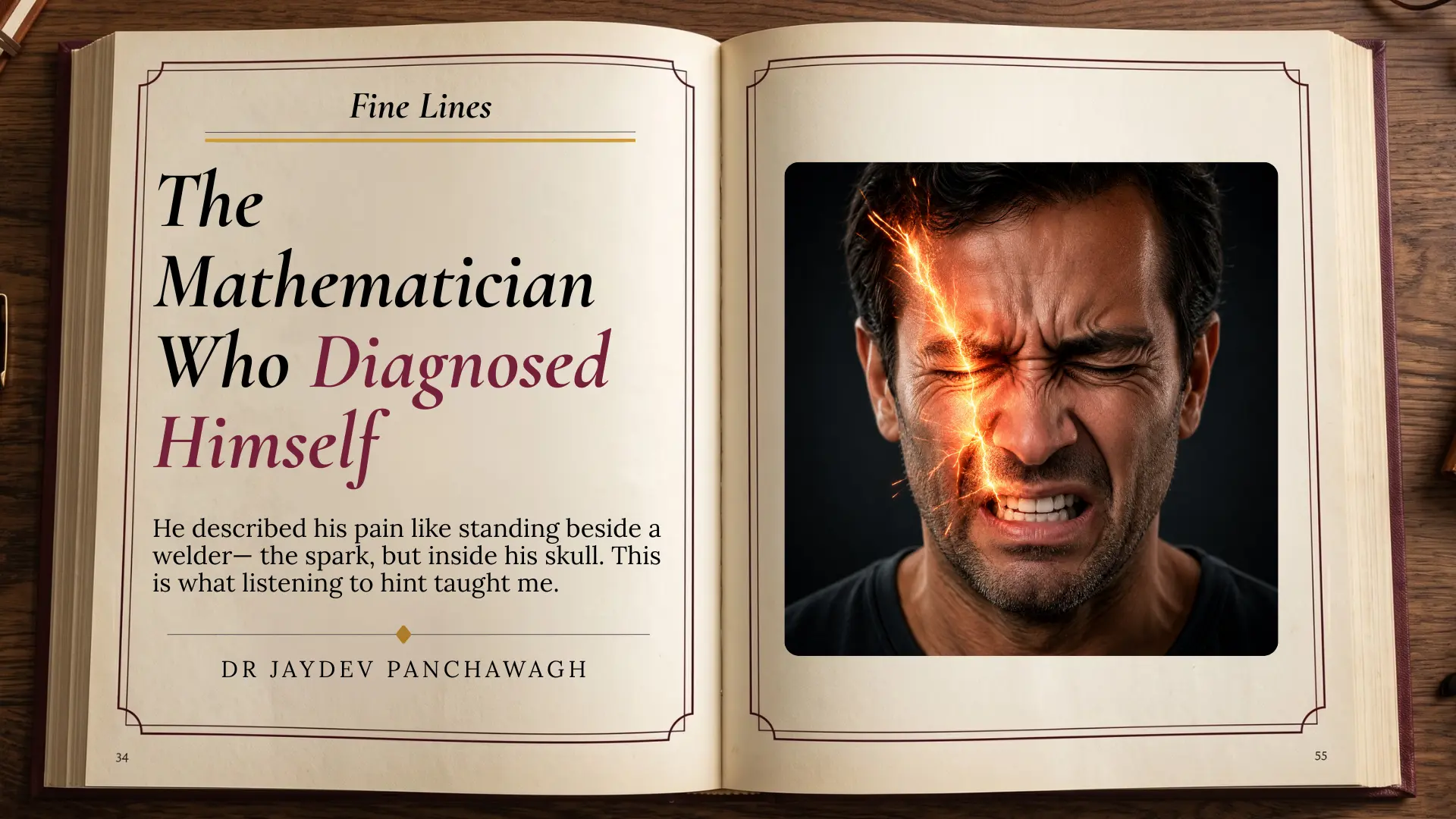
Eight years of trigeminal neuralgia. A photograph on a Tuesday morning. And what MVD surgery gives back that no medication can.
It is considered one of the most severe pains the human nervous system can produce. There is a reason it was once called the suicide disease. I do not reach for that phrase easily.
The photograph arrived on a Tuesday morning, between two clinic appointments. A hill somewhere in the background. A man, a woman, a small child. All three of them laughing — the kind of photograph people take without thinking, because they are too busy being happy to think about the camera. His wife had written two lines beneath it. We got our husband and father back.
I set my phone down and sat with that for a moment. In twenty-seven years of operating on the human nervous system, I have learned that the measure of surgery is rarely what happens in the theatre. It is what happens in photographs like this one.
Mr. Joshi had come to me eight months earlier wearing a scarf. It was May. Pune in May does not ask for scarves.
He is forty years old, a pharmaceutical salesman from Bhopal. His work is the road — two-wheeler, city to city, wind in his face, client to client. Or it had been, once. By the time he sat across from me, he had not done a full day of field work in years. He had stopped wearing a helmet because the chin strap triggered the pain. He had stopped taking the morning routes because the air was cooler then, and cooler meant sharper, and sharper meant the thing that happened to his face.
The thing that happened to his face was Trigeminal Neuralgia. It had begun eight years earlier, when he was thirty-two. A pain in the upper jaw — fleeting, electric, gone before he could describe it. He thought it was a tooth. His dentist thought it was a tooth. One extraction later, the pain was still there and there was one less tooth. He moved through four or five doctors over several months before someone finally named it correctly.
The Trigeminal nerve is the fifth cranial nerve — the largest of the twelve that arise from the brain. Its three branches carry all sensation from the face: the forehead and eye above, the cheek and upper jaw in the middle, the lower jaw and chin below. In some people, an artery makes contact with the nerve at the precise point where it enters the brainstem — the root entry zone, where the myelin sheath is thinnest and most vulnerable. The artery presses. It pulses sixty, seventy, eighty times a minute, every minute of every day. Over months and years, that pulsatile pressure erodes the myelin. Bare nerve fibres are exposed. And the nerve, stripped of its insulation, begins to misfire — sending volleys of pain in response to the lightest, most innocent stimuli.
A sip of cold water. A breeze on the cheek. The touch of a toothbrush. The strap of a helmet. Each of these — innocuous, unremarkable acts of an ordinary day — becomes, in Trigeminal Neuralgia, the trigger for an electric shock of pain that erupts without warning on one side of the face and vanishes before the patient can even cry out.
What the patient feels is a bolt of electricity through the face. It lasts seconds. It is, by the consistent testimony of those who have lived with it, among the most severe pains the human nervous system can produce. There is a reason it was once called the suicide disease. I do not reach for that phrase easily. I use it here because Mr. Joshi needs you to understand what eight years of this does to a man — eight years of electric pain that arrives without warning, that leaves you not only with relief but also with dread. Dread of the next attack. Dread of the sip of water, the gust of wind, the careless touch. The pain itself lasts seconds. The terror of the pain lasts every waking hour. That is the true weight of Trigeminal Neuralgia — not just what it does to the face, but what it does to the mind that lives inside the face, always waiting, never knowing when the lightning will strike again.
He was put on carbamazepine — the standard first-line medication for Trigeminal Neuralgia. It quieted the nerve, partially. Enough to keep going, for a time. But carbamazepine is an anticonvulsant that works by suppressing electrical activity across the entire nervous system, not only in one small misfiring nerve. The result is a whole-body dimming. Drowsiness. A blunting of thought. The sense — which patient after patient describes to me in almost identical words — of watching life from behind glass.
"I was present, but I wasn't really there."
That is what Mr. Joshi told me, months after his surgery, when he could speak about it clearly. He was still showing up. Still riding shorter routes with a face mask to shield his cheek from the wind. Still coming home. Still doing what needed to be done. But something in him had gone quiet. His income had fallen. His manager had noticed.
And around this time, he got married.
His wife had married the man she loved. She had certain expectations of their life together — entirely ordinary ones. An evening out, friends over, a family gathering, a trip somewhere. What she found was a husband who flinched when she touched his face, who went silent without explanation on some evenings, who could not wear a helmet, who declined most invitations. Chronic pain, poorly understood by those outside it, is very good at creating distance between people who love each other. Not through cruelty. Through silence and the slow accumulation of things not said.
This is what Trigeminal Neuralgia does to a marriage — quietly, without anyone being the villain. There was only a man in pain, and a woman who loved him, and the enormous distance that pain had quietly built between them.
Then they had a child.
What Mr. Joshi told me about this, he had not been able to tell anyone. He was afraid of his own baby. He loved the child without reservation. But babies reach for your face. They press a small palm against your jaw, grab your cheek, lean their forehead into yours. For a Trigeminal Neuralgia patient, that touch — however soft, however full of love — can fire the nerve and bring the lightning down. So he held back from his own infant. His wife, exhausted, managing most of it alone, began to carry a weight she could not name or explain even to her own parents. Two people who loved each other, living in the same house, growing quietly apart.
And Then There Was a Life-Changing Phone Call
How a friend's recovery from Hemifacial Spasm opened a door that medications had kept shut
An old friend called, one afternoon.
This friend had been living with Hemifacial Spasm — a different condition, a different cranial nerve, but the same underlying mechanism: a blood vessel pressing on a nerve at the brainstem, causing one side of the face to twitch without warning. He had come to Pune for Microvascular Decompression surgery. He was well now. The twitching was gone. The anxiety was gone. He was himself again.
He told Mr. Joshi: just go once. Just talk to them.
Mr. Joshi was skeptical — he had heard things before, and hope, when it has been disappointed enough times, learns to travel quietly. But there was something in his friend’s account that was different. Not a testimonial. Not enthusiasm. Just the plain, unremarkable calm of a man who had been through something and come out the other side. So Mr. Joshi came to Pune. He brought his wife with him, which told me something before he had said a word — when a patient walks in with their spouse, they have already decided that whatever this is, it is serious enough to face together.
We see patients at our MVD centre from across India — Mumbai, Delhi, Hyderabad, Nagpur — and from abroad, for Trigeminal Neuralgia, Glossopharyngeal Neuralgia, and Hemifacial Spasm. Each one arrives carrying years. What they need before anything else is not a surgical plan. They need to feel that the person across the table has seen this before and understands what it takes from a life.
Understanding Microvascular Decompression Surgery — and Why It Works
The questions patients ask most, and the honest answers they deserve
We spent nearly two hours with Mr. and Mrs. Joshi. The questions they asked are the questions every patient asks, and every patient deserves a full answer to. Is MVD surgery safe? What is the recovery like? Will the pain come back? How do I know if I am the right candidate? Is it better than the other procedures — the Gamma Knife, the radiofrequency ablation, the glycerol injections? We went through all of it. What Microvascular Decompression surgery involves, step by step. What to expect in the days after. What a successful outcome looks and feels like — and, honestly, what it does not guarantee. The difference between MVD and nerve ablation procedures is important: ablation silences the nerve by damaging it; MVD removes the cause without harming the nerve at all. For patients with confirmed Neurovascular Compression on MRI — as Mr. Joshi had — this matters enormously. Somewhere in that conversation, Mr. Joshi said something I noted.
"This is the first time I feel like someone actually knows what this is like."
His MRI was unambiguous. A blood vessel in direct contact with the Trigeminal nerve at the root entry zone — the anatomical substrate of classical Trigeminal Neuralgia. A clear indication for Microvascular Decompression.
Microvascular Decompression is performed through a small opening behind the ear. The operating microscope illuminates the posterior fossa. The cerebellum is gently retracted. The Trigeminal nerve comes into view at the brainstem — and there, exactly where the imaging had shown it, the offending vessel. Under high magnification, it is carefully dissected free from the nerve and a small Teflon pledget placed between them, cushioning the nerve permanently from further contact. Nothing is cut. Nothing is ablated. The anatomy is restored, as closely as possible, to what it should have been.
They returned to Bhopal that evening. For the first time in a long time, Mr. Joshi left a consultation carrying something other than a revised prescription.
Is Microvascular Decompression Surgery Right for You? The Conversation That Matters Most
When a patient reads out his fears one by one, the surgeon must be ready to answer every single one
About a month later, Mr. Joshi asked for an online consultation. He had sat with everything we had discussed, turned it over quietly with his wife, and arrived at the call with a written list of questions he read out to me one by one. I find these lists deeply moving. They represent weeks of courage — the courage to hope carefully, to research without spiralling, to put fear into words and then speak them to a stranger. We talked through every question with complete frankness. The risks. The recovery. What Microvascular Decompression surgery for Trigeminal Neuralgia can reliably offer and what it cannot promise. In our own surgical series, patients like him — classical symptoms, and compression clearly visible on the MRI — are the ones who tend to do best. But numbers, ours or anyone else’s, only mean something when a patient can place them next to their own MRI, their own eight years, their own threshold for risk. That is what we did together. No performance. No reassurance that was not earned. At the end of the call, he told me he wanted to go ahead.
Three Months After MVD Surgery
What it means when a scarf becomes just a scarf
It has now been three months since the operation.
Mr. Joshi is pain-free. He is off all medications. The drowsiness has gone, the blunting of thought has lifted. The driving routes for his professional work are getting longer again. The scarf is still in his bag — not because he needs it. Just habit, he told me, and then laughed a little at himself for saying it.
And then, on a Tuesday morning, the photograph. A hill in the background. All three of them laughing. His wife had written two lines beneath it. We went on our first family trip last week. I have my husband back, and my child has his father.
I have operated on this condition many times. The surgery itself I can describe with precision — the angle of the retractor, the first glimpse of the nerve, the moment the vessel is lifted free. What I cannot describe with equal precision is what that photograph contains: the sum of eight years of a man’s life — the routes he did not ride, the child he was afraid to hold, the evenings his wife spent alone in a house he was also in — and then its absence. Not gradually. Completely.
This is what Microvascular Decompression does, when it is done for the right patient, at the right time, by a team that has done it enough times to do it well. It does not merely remove pain. It returns a person to their own life.
There are people reading this who are living some version of Mr. Joshi’s story. The face that flinches at the wind. The marriage growing quietly strange. The distance from a child they love completely, but whom they are afraid to hold. They suffer not because there is no answer, but because no one has yet told them that the answer exists.
That is the only reason I write these essays.
Names and identifying details have been changed to protect patient privacy. Shared with the patient’s consent.