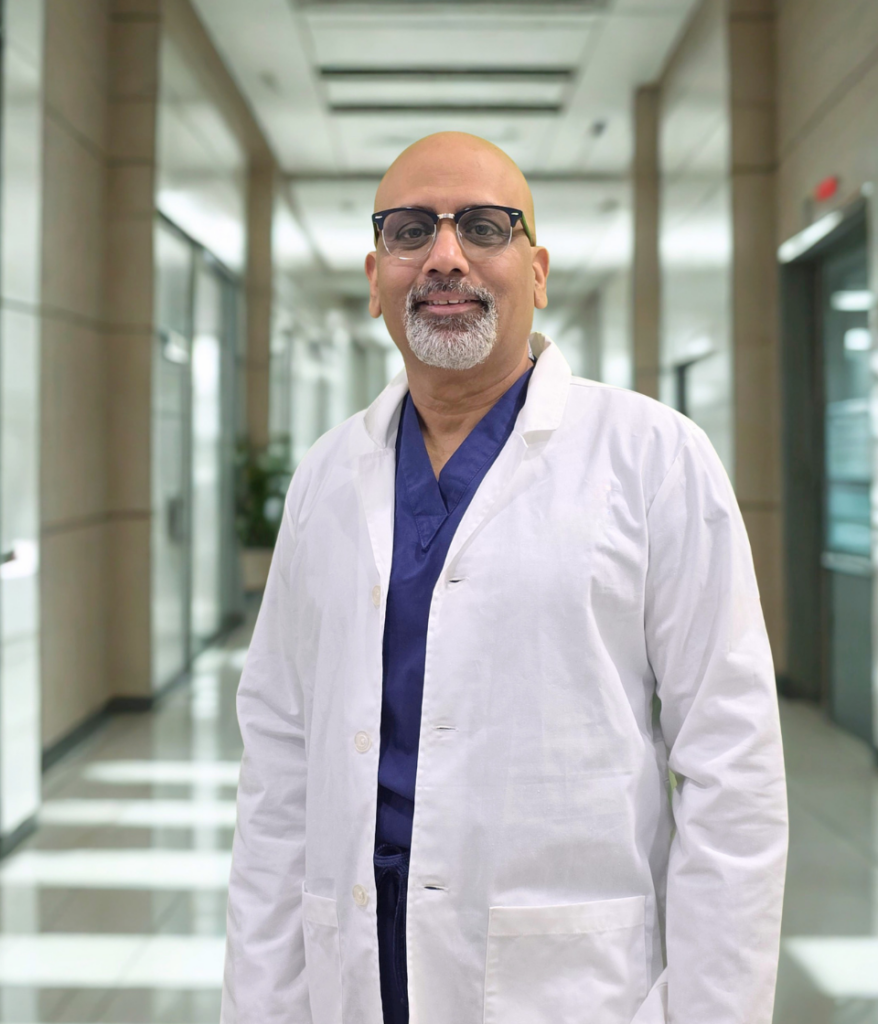
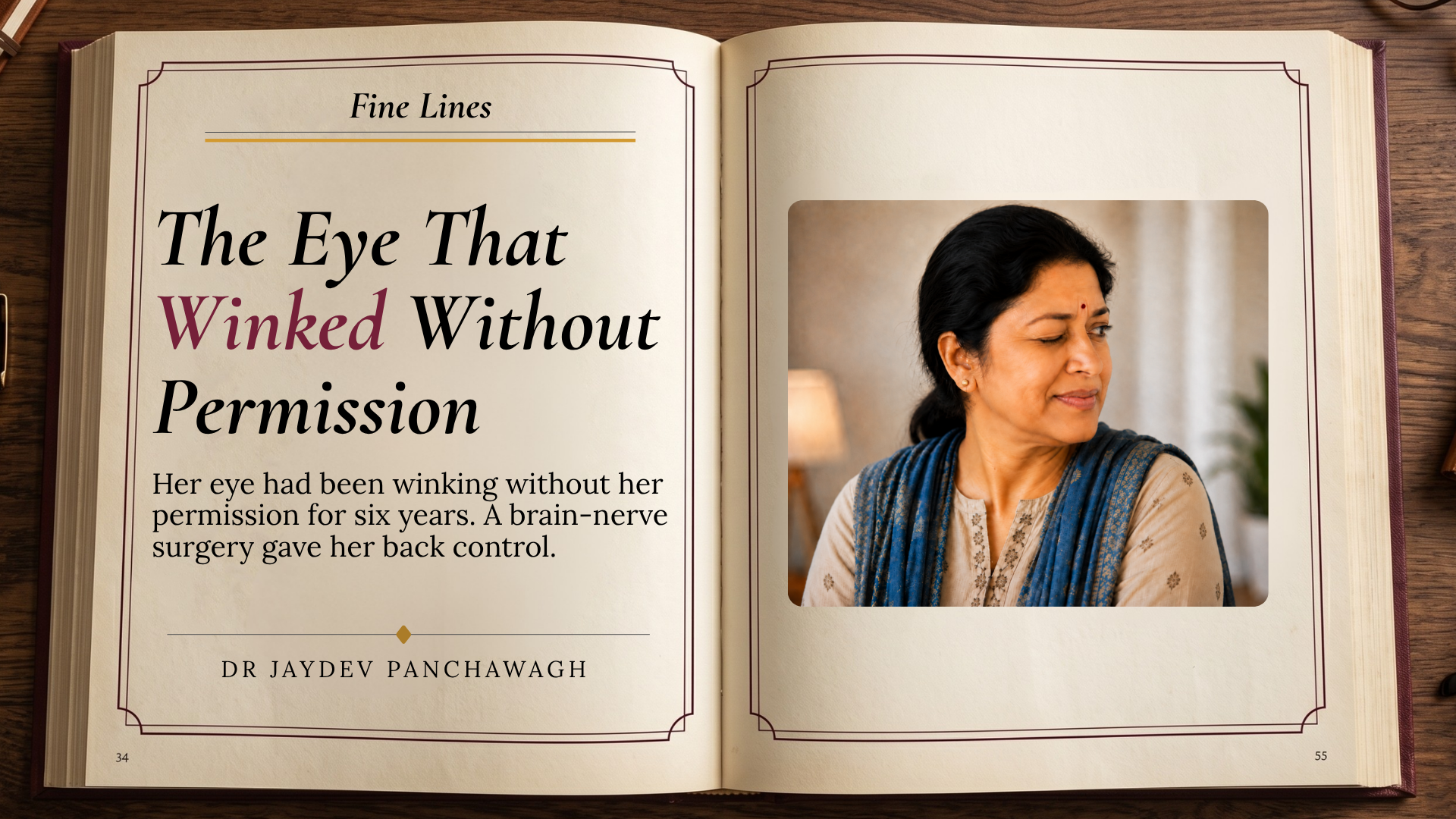
A patient walked into my OPD not long ago with a familiar story — pain that could be triggered by a breeze, a bite of food, the wrong angle of a toothbrush. I began the way I always do: confirming the diagnosis of Trigeminal Neuralgia, then explaining why Microvascular Decompression, not another year of medication, offered him the best chance at lasting relief.
He stopped me before I had finished the sentence.
While waiting outside, he told me, he had already spoken to three other patients in the room. One had undergone the same surgery two weeks earlier, and was there only to get the stitches removed. That patient told him exactly what the first two weeks felt like. Another patient also had Trigeminal Neuralgia and was still deciding whether to go ahead with surgery. The two of them talked about the same fear. A third patient had Hemifacial Spasm and was there only to decide a date for surgery. By the time he sat down in front of me, he had already made up his mind. I had barely finished a sentence.
I have thought about that waiting room episode often. Nothing I say in a consultation will ever be as persuasive as an ordinary conversation between strangers who happen to be sitting in the same room, waiting for the same door to open. What convinced him was not my explanation of risk and benefit. It was the accumulated, unrehearsed testimony of people who had already walked the road he was about to take.
Why Trigeminal Neuralgia Treatment Became a Life's Focus
A pain with no patience for ordinary explanations
Trigeminal Neuralgia is widely regarded as one of the most severe forms of facial pain in medicine, with attacks triggered by something as ordinary as a breeze, a shave, or the touch of a pillow. Twenty-two years ago, that severity was the entire reason this dedicated work began. Not a technique chosen for its elegance. Not a subspecialty selected for its rarity. A patient’s pain, and the conviction that it could be relieved, properly, with the right hands and the right care.
It is worth pausing on why this particular family of conditions resists the ordinary tools of medicine for so long before a patient ever reaches a neurosurgeon’s office. A pulsing artery, over years, wears a groove into the sheath of a nearby nerve, the way water eventually shapes stone. The nerve does not break. It misfires — sending pain, spasm, or a swallowing reflex gone wrong, in response to sensations that should never have triggered anything at all. No pill silences a nerve rubbed raw in this way for long, which is precisely why so many patients arrive having already tried, and exhausted, every medication available to them.
This focus soon extended to Hemifacial Spasm and Glossopharyngeal Neuralgia as well. The three conditions look different on the surface, but share the same underlying mechanism: a blood vessel compressing a cranial nerve, producing symptoms far more disabling than their physical cause would suggest. Facial pain, involuntary facial spasm, and pain or difficulty with swallowing are each disabling in their own way, and each has been treated with the same seriousness of surgical attention as the first.
What Twenty-Two Years of Microvascular Decompression Surgery Teaches
Repetition builds a kind of sight
More than 3000 Microvascular Decompressions later, across all three conditions, the number itself means little on its own. What matters is what’s behind that number. Repetition builds a kind of pattern recognition nothing else can. Over the years, I have come to recognise almost every variation a nerve and vessel can produce. And the outcomes have stayed steady — because this same operation has been done, at this scale, for over two decades. Very few centres anywhere in the world have performed this surgery, across these three conditions, this many times. I say this as fact, not as a boast — and as a reminder of where the real solution lies. Medicine can dull the pain for a while. It cannot move the vessel off the nerve. Only surgery does that.
The number matters less than what it represents — pattern recognition that only experience can build.
There is a particular moment, familiar now in a way it was not twenty years ago, when the microscope reveals the offending vessel lying against the nerve root, and the shape of the problem simply announces itself. That recognition is not instinct. It is the residue of thousands of prior encounters with the same anatomy, filed away without ever having been consciously counted.
Why No Neurosurgeon Can Operate Alone
The team behind one pair of hands
Volume alone does not make a centre good, and it has never been the whole story here. It is possible to accumulate high case numbers without genuine attention to patient wellbeing. That is not the intent behind this work. The same concern that started it — treating pain that surgery could actually resolve — eventually led beyond the operating room, to the founding of a dedicated foundation. Two counsellors now work within it specifically for patients living with these conditions, because correcting a nerve surgically does not, by itself, undo months or years of a person having organised their life around avoiding pain. That requires conversation, patience, and time that a surgical schedule alone does not provide.
I stand at the centre of a system built, patient by patient, over twenty years — and I lean on it every single time.
None of this, it should be said plainly, is the work of one person. As the operating neurosurgeon, I stand at the centre of a system built, patient by patient, over twenty years — and I lean on it every single time. Two assisting neurosurgeon colleagues share the table with me for every procedure. An anaesthesia team that has now anaesthetised MVD patients for over twenty years understands this surgery’s particular demands in a way that cannot be taught quickly. A postoperative care team knows the nuances of recovery that are unique to this operation — the small signs that matter, the complications to watch for, the reassurance a frightened patient needs in the early hours after surgery. Beyond the hospital, the Synapse Brain and Spine Foundation and our Indo-German partnership, Neurochirurgische Hilfe Indien, hold the wider structure together. And beyond even that, there are the patients themselves — men and women who once sat where a new patient sits now, and who have formed support groups for those living with Trigeminal Neuralgia, Hemifacial Spasm, and Glossopharyngeal Neuralgia, offering something no clinician can: the assurance of someone who has actually been there.
There is another layer to this — one that rarely comes up with a patient. It has nothing to do with their nerve or vessel. It has everything to do with something else: whether this surgery will still be done well long after I have left the operating theatre for the last time.
Younger neurosurgeons have trained here specifically in this operation, on this volume of cases, in a way that would take them years to accumulate elsewhere on their own. Some of that learning has been written down — not as self-promotion, but because a technique refined over thousands of cases is only truly useful if it can be taught to hands that are not one’s own.
Measuring MVD Surgery Outcomes Over Two Decades
What consistency actually looks like
There are two different numbers a surgeon can point to. One is how many operations he has done. The other is how many of them went well — and whether that second number has stayed steady even as the first kept growing. Both matter. But the second is what gives the first its real meaning. A success rate that holds steady or gets better as the number of surgeries climbs into the thousands reflects something else: a team and a set of protocols that have been tested and refined case after case, not just one pair of hands getting faster. That is what a single good year can never show.
Good outcomes, repeated enough times, stop looking like victories and start looking like routine.
What this looks like, in practice, is almost anticlimactic. A patient who arrived flinching at the memory of a breeze on her cheek, walking out of the ward two days later, unremarkable, already impatient to go home. There is no drama in it, and that absence of drama is the point. Good outcomes, repeated enough times, stop looking like victories and start looking like routine. It is precisely that routine — earned slowly, guarded carefully — that a patient travelling from another city is really buying with the extra hours on the road.
Choosing a Neurosurgeon: Who Are You, and Can This Be Trusted
The question every patient should ask
The neurovascular project grew from the same place. It did not begin as a plan to expand a practice. It began as a slow, growing feeling — that everything learned over these years deserved a proper home. Organised. Examined. Written down. So that it could outlast any one pair of hands. So that it could be useful to other surgeons who treat these conditions, and to patients trying to understand what is actually being proposed to them.
None of this is offered as a boast. It is offered as an answer to a fair question every patient considering this surgery should ask: who are you, and can this be trusted? The answer rests on twenty-two years of a single, specific focus; a volume of experience that is unusual almost anywhere in the world; a team built deliberately around this one operation; and a commitment to outcomes that has stayed consistent since the work began. Technology helps. Technique helps more. But what has sustained this work, case after case, is attention to outcome that has not diminished over time.
A number, on its own, proves nothing. What it can do, if it is honest, is answer one question for a frightened person on the other end of a phone call: will I be safe, or will I be the exception the surgeon is still learning from? That is the only weight worth carrying into an operating theatre. Not the size of the record. The promise it quietly makes to the next patient — the one still deciding whether the longer journey is worth making.
Names and identifying details have been changed to protect patient privacy. Shared with the patient’s consent.