The Weight We Have Chosen to Carry
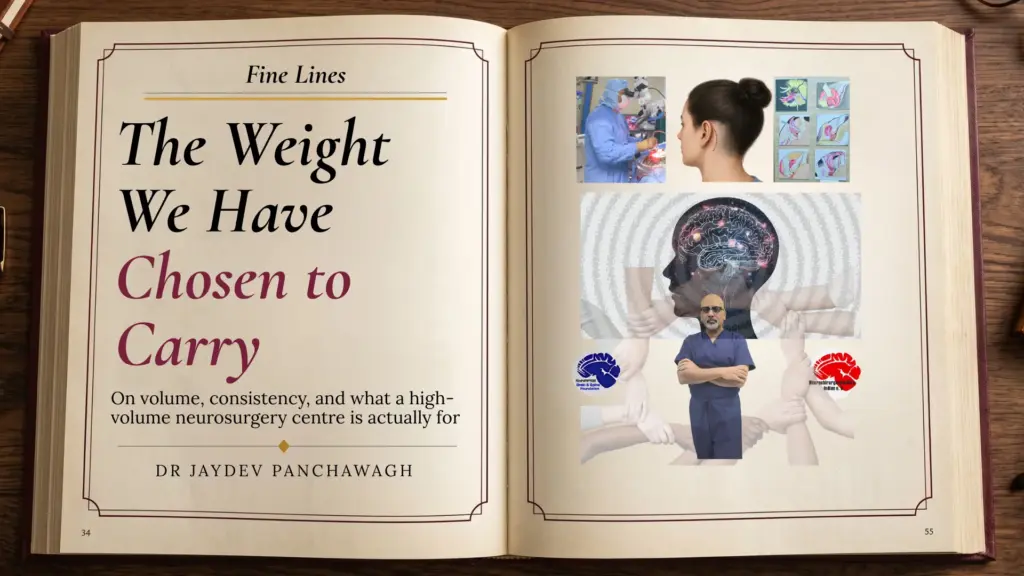
A patient walked into my OPD not long ago with a familiar story — pain that could be triggered by a breeze, a bite of food, the wrong angle of a toothbrush. I began the way I always do: confirming the diagnosis of Trigeminal Neuralgia, then explaining why Microvascular Decompression, not another year of medication, offered him the best chance at lasting relief. He stopped me before I had finished the sentence. While waiting outside, he told me, he had already spoken to three other patients in the room. One had undergone the same surgery two weeks earlier, and was there only to get the stitches removed. That patient told him exactly what the first two weeks felt like. Another patient also had Trigeminal Neuralgia and was still deciding whether to go ahead with surgery. The two of them talked about the same fear. A third patient had Hemifacial Spasm and was there only to decide a date for surgery. By the time he sat down in front of me, he had already made up his mind. I had barely finished a sentence. I have thought about that waiting room episode often. Nothing I say in a consultation will ever be as persuasive as an ordinary conversation between strangers who happen to be sitting in the same room, waiting for the same door to open. What convinced him was not my explanation of risk and benefit. It was the accumulated, unrehearsed testimony of people who had already walked the road he was about to take. Why Trigeminal Neuralgia Treatment Became a Life’s Focus A pain with no patience for ordinary explanations Trigeminal Neuralgia is widely regarded as one of the most severe forms of facial pain in medicine, with attacks triggered by something as ordinary as a breeze, a shave, or the touch of a pillow. Twenty-two years ago, that severity was the entire reason this dedicated work began. Not a technique chosen for its elegance. Not a subspecialty selected for its rarity. A patient’s pain, and the conviction that it could be relieved, properly, with the right hands and the right care. It is worth pausing on why this particular family of conditions resists the ordinary tools of medicine for so long before a patient ever reaches a neurosurgeon’s office. A pulsing artery, over years, wears a groove into the sheath of a nearby nerve, the way water eventually shapes stone. The nerve does not break. It misfires — sending pain, spasm, or a swallowing reflex gone wrong, in response to sensations that should never have triggered anything at all. No pill silences a nerve rubbed raw in this way for long, which is precisely why so many patients arrive having already tried, and exhausted, every medication available to them. This focus soon extended to Hemifacial Spasm and Glossopharyngeal Neuralgia as well. The three conditions look different on the surface, but share the same underlying mechanism: a blood vessel compressing a cranial nerve, producing symptoms far more disabling than their physical cause would suggest. Facial pain, involuntary facial spasm, and pain or difficulty with swallowing are each disabling in their own way, and each has been treated with the same seriousness of surgical attention as the first. What Twenty-Two Years of Microvascular Decompression Surgery Teaches Repetition builds a kind of sight More than 3000 Microvascular Decompressions later, across all three conditions, the number itself means little on its own. What matters is what’s behind that number. Repetition builds a kind of pattern recognition nothing else can. Over the years, I have come to recognise almost every variation a nerve and vessel can produce. And the outcomes have stayed steady — because this same operation has been done, at this scale, for over two decades. Very few centres anywhere in the world have performed this surgery, across these three conditions, this many times. I say this as fact, not as a boast — and as a reminder of where the real solution lies. Medicine can dull the pain for a while. It cannot move the vessel off the nerve. Only surgery does that. The number matters less than what it represents — pattern recognition that only experience can build. There is a particular moment, familiar now in a way it was not twenty years ago, when the microscope reveals the offending vessel lying against the nerve root, and the shape of the problem simply announces itself. That recognition is not instinct. It is the residue of thousands of prior encounters with the same anatomy, filed away without ever having been consciously counted. Why No Neurosurgeon Can Operate Alone The team behind one pair of hands Volume alone does not make a centre good, and it has never been the whole story here. It is possible to accumulate high case numbers without genuine attention to patient wellbeing. That is not the intent behind this work. The same concern that started it — treating pain that surgery could actually resolve — eventually led beyond the operating room, to the founding of a dedicated foundation. Two counsellors now work within it specifically for patients living with these conditions, because correcting a nerve surgically does not, by itself, undo months or years of a person having organised their life around avoiding pain. That requires conversation, patience, and time that a surgical schedule alone does not provide. I stand at the centre of a system built, patient by patient, over twenty years — and I lean on it every single time. None of this, it should be said plainly, is the work of one person. As the operating neurosurgeon, I stand at the centre of a system built, patient by patient, over twenty years — and I lean on it every single time. Two assisting neurosurgeon colleagues share the table with me for every procedure. An anaesthesia team that has now anaesthetised MVD patients for over twenty years understands this surgery’s particular demands in a way that cannot be taught quickly. A postoperative care
A Crooked Smile
A neurosurgeon’s account of the disorder that steals the face — and the surgery that gives it back “This condition does not kill. It does not blind. It leaves no visible scar.And yet — in a career spent operating inside the human nervous system —it ranks among the cruelest disorders I have encountered.” — Dr Jaydev Panchawagh · MVD Surgery Centre, Pune This neurological condition does not kill. It does not blind. It leaves no visible scar. And yet, in the quiet devastation it delivers to ordinary life, it ranks among the cruelest disorders I have encountered in a career spent operating inside the human nervous system. It is called Hemifacial Spasm — HFS, in the shorthand of neurology. In Marathi, lacking a precise equivalent, I once named it myself in an article. The disease of the winking eye. Or simply, the winking disorder. The name stuck. It fits, with uncomfortable accuracy. Over the past twenty years, practising out of Pune — the hub of education and culture in India — we have dedicated ourselves to this particular corner of neurosurgery: Microvascular Decompression, or MVD. In that time, I have met hundreds of patients carrying this condition. I have watched it shrink lives. I have watched it end marriages, cost jobs, and confine spirited human beings to the narrow shelter of their own homes. And I have, thankfully, watched surgery set most of them free. This is what I want to write about. Not the disease alone — but the disturbing stories it produces. The misunderstanding that surrounds it. And most importantly, the treatment that exists but remains, bewilderingly, unknown to most who actually need it. What Exactly Happens Picture the face of someone you know. Now imagine that, without warning or invitation, one side of that face begins to move on its own — in twitches, in spasms. It begins small. A flutter near the eye. A twitch of the eyelid — the kind every tired person has felt at the end of a long day. Easy to dismiss. Easy to wait out. But in hemifacial spasm, the waiting changes nothing. The flutter does not subside. It returns. It returns more often. It becomes a wink. Over months and years, the spasm migrates southward along the face. The cheek joins the eye. Then the corner of the mouth. One entire side of the face begins to contract — repeatedly, involuntarily, without notice — and always, with grotesque timing, at the worst possible moments: at the bank counter, in the classroom, at the reception desk, across the dinner table. “The affected person appears to be winking deliberately. In reality, they have no more control over that wink than over the beating of their heart.” Stories That Refuse to Leave Sandeep was in his mid-thirties when he came to our clinic in Pune, his wife Swati beside him. He held his right hand cupped against the right side of his face — a gesture I have seen so many times now that I recognise it before the patient even sits down. It is the posture of someone trying to hide themselves from the world. Swati told me what had happened the previous week. Sandeep had been standing at a bus stop in Mumbai, reading a magazine. The woman to his right turned on him suddenly. She was furious. She said: “Aren’t you ashamed? Winking like that? Do it again and I will call the police.” Before he could explain, two bystanders had struck him. This happened. It is not embellished. I write it as it was told to me, by the man who lived it. “If only I had known this could be cured. If only someone had told me. The years I lost.” Voices from Across India — and the World From Chennai: a young woman who worked at the reception desk of a prominent company. At thirty-two, spasms arrived. She lost the job she had built her career around. From Jharkhand: a young man whose marriage proposals kept dissolving. From Mumbai: a man whose marriage ended. From Kerala: a sixty-five-year-old who had not slept soundly in years. From Africa: a young man who told me, with a quiet sadness I still remember, that no woman on any bus would sit across from him. The Architecture of the Problem The facial nerve — the seventh cranial nerve — governs every muscle of expression. Smile, frown, blink, squint: all of it moves on this nerve’s command. Near its origin at the brainstem, there is a brief stretch where its protective myelin sheath changes character — from central myelin to peripheral myelin. The Root Exit Zone — Where Vulnerability Lives Think of the stitching at the cuff of a shirt sleeve. Usually seamless. But occasionally, the myelin sheath of some facial nerves is not stitched properly at this delicate transition zone — the Root Exit Zone. There are gaps. Potential vulnerabilities, waiting. A blood vessel comes to rest against this vulnerable segment and pulsates with each heartbeat. Tap, tap, tap. Thousands of times a day. In neurosurgical language: a neurovascular conflict. Over time, the friction erodes the myelin — the nerve’s electrical insulation. When insulation fails, signals short-circuit. The facial muscles start receiving signals they were never sent. They contract. They spasm. The face begins its involuntary performance. The Surgery That Cures There is one and only one treatment that addresses the cause of hemifacial spasm rather than its symptoms: Microvascular Decompression — MVD. Through a small opening behind the ear, the neurosurgeon places a small pad of Teflon between artery and nerve. The mechanical irritation ends. The myelin regenerates. The spasms stop. “We are what we repeatedly do. Excellence, then, is not an act, but a habit.” — Aristotle Our Results — MVD Surgery Centre, Pune Our centre, established in 2004, has performed more than 775 MVD operations. Results presented at national and international conferences from 2014 through 2025. Failure rate: one percent. Complications declining steadily with accumulated experience. An
