The Mathematician Who Diagnosed Himself
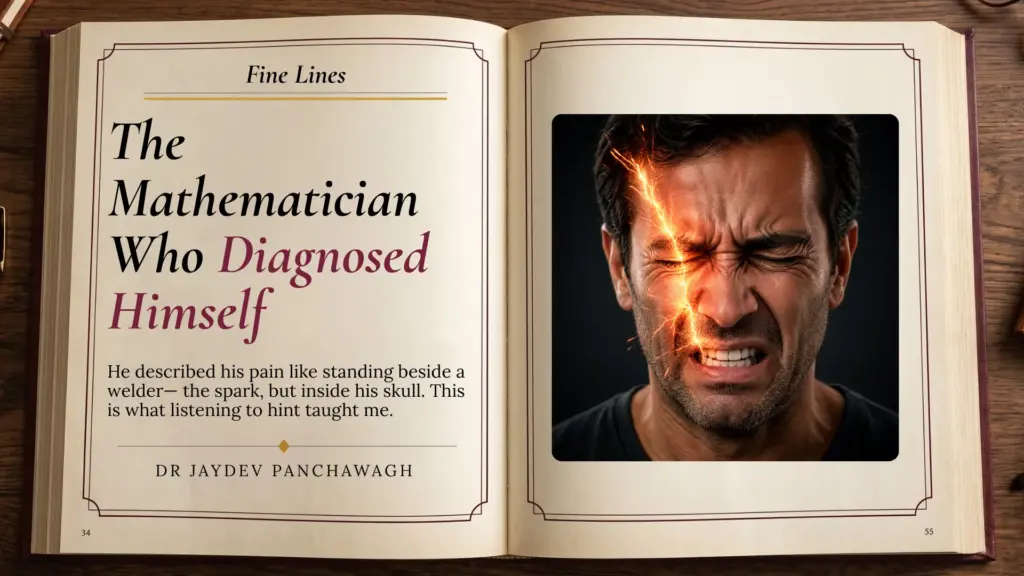
In this piece Diagnosing Trigeminal Neuralgia: A Patient Who Noticed What Doctors Missed Living With Trigeminal Neuralgia: Four Years Before Surgery What Trigeminal Neuralgia Patients Teach Me That No Textbook Can Trigeminal Neuralgia Surgery: A Mathematician’s Approach to Risk Life After Trigeminal Neuralgia Surgery: Six Years On Trigeminal Neuralgia Awareness: Why I Keep Telling This Story I operated on DKM in February 2020. When he sat across from me again this July — over six years later — I noticed something I see in most operated patients. Confidence in body movements, knowing that a pain attack is not around the corner. His face was calm. It had always been calm. Even back when he was describing his pain to me for the first time, before surgery. What has changed is everything underneath that calm. Before surgery, that stillness was braced. Waiting for pain to come any moment. A person living with Trigeminal Neuralgia learns to carry a kind of low-grade anticipation everywhere — will the fan turn on, will someone brush past my face, will I need to brush my teeth soon. Will the pain come when I chew or open my mouth? What if I have to talk? That tension doesn’t always show up in what a patient says. It shows up in how they hold themselves. This July, that tension simply wasn’t there. He sat the way a person sits when their body has genuinely stopped expecting pain. I’ve learned to watch for that shift over the years, and it’s one of the more honest signs of a good outcome — more honest, sometimes, than what patients say out loud. He’s been back to see me twice since his surgery. Not for follow-up in the clinical sense — just to say hello. Both times, he’s asked to sit in on my OPD for a while and talk to patients who are currently living with Trigeminal Neuralgia, sharing what it was like for him, before and after. He offers to do this as his social responsibility of spreading awareness and supporting diagnosed patients. How Acromegaly Hides in Plain Sight The body changes too gradual to notice Acromegaly is a disease of slowness. It is caused, in almost every case, by a small benign tumour of the pituitary gland that pours out too much growth hormone. The hormone does its work by fractions. A millimetre here. A half-size there. The face you meet each morning is never very different from the face you met the morning before, and so the change escapes you. By the time it announces itself, it has usually been at work for years. Across large studies, the gap between the first sign of acromegaly and the diagnosis runs to seven, eight, sometimes ten years. Diagnosing Trigeminal Neuralgia: A Patient Who Noticed What Doctors Missed DKM is a professor of mathematics at a prestigious university in North India. I think that detail matters, because of how precisely he arrived at his own diagnosis — well before any doctor was willing to commit to it. He arrived, having filtered it correctly. It began with a strange, brief electric flash across his forehead while drying himself with a towel after a bath. Most people would let a sensation like that pass. He noticed it, dismissed it once, and then paid close attention when it happened again in exactly the same way, doing exactly the same thing. Most doctors who are otherwise familiar with this disease may tend to overlook an occasional, brief, electric-shock-like pain — because it’s occasional, because it passes quickly, because on its own it doesn’t look alarming. What an intelligent, observant patient notices, and what a medical consultation may often miss, is that this pain is different in character from ordinary pain, and that it’s unusual precisely because it follows specific, repeatable triggers. A towel on the forehead. Cold water. A breeze. That pattern is the disease announcing itself, long before it becomes impossible to ignore. DKM saw three doctors before anyone would use the words Trigeminal Neuralgia. He’d already found the term himself by then, matched his own symptoms against the clinical description, and was, in effect, waiting for a doctor to catch up to a conclusion he’d already reasoned his way to. That’s not something I see often. Most patients arrive overwhelmed by conflicting information. He arrived, having filtered it correctly. Living With Trigeminal Neuralgia: Four Years Before Surgery The four years between his first symptom and his surgery tell you more about this disease than any textbook does. Like standing beside someone welding — except the electrode was inside his own head. He kept teaching through all of it. In his city, winters are harsh — temperatures can fall to two or three degrees Celsius — and cold is one of the more reliable triggers for this kind of pain, which is why winter tends to be the hardest season for almost every Trigeminal Neuralgia patient I treat, not just him. He wore two caps and wrapped a wool band across his forehead to get through those months. He bathed every day knowing, with total certainty, that the moment water touched his forehead, the pain was coming. He did it anyway, because there wasn’t another option. His oxcarbazepine daily dose climbed from 200mg to 1,200mg over the course of a year as the disease progressed, controlling the pain somewhat, but leaving him with a constant dull heaviness that never fully lifted. He described the pain itself in a way that still gives me goosebumps: like standing beside someone welding — the electrode sparking against metal — except the electrode was inside his own head. Three to five seconds of it, he told me, but so intense that anything longer would be unsurvivable. What Trigeminal Neuralgia Patients Teach Me That No Textbook Can My training in neurosurgery, and MVD surgery, taught me the pathophysiology of Trigeminal Neuralgia — the symptoms, the vascular compression, the pain pathways, the mechanism behind why decompression works. It
The Face That Feared the Wind
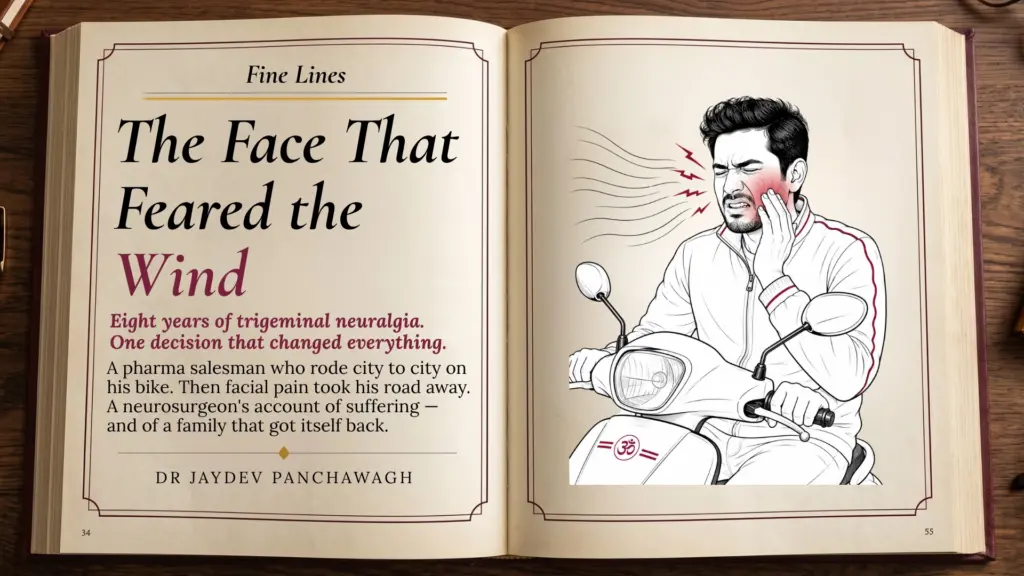
Eight years of trigeminal neuralgia. A photograph on a Tuesday morning. And what MVD surgery gives back that no medication can. It is considered one of the most severe pains the human nervous system can produce. There is a reason it was once called the suicide disease. I do not reach for that phrase easily. The photograph arrived on a Tuesday morning, between two clinic appointments. A hill somewhere in the background. A man, a woman, a small child. All three of them laughing — the kind of photograph people take without thinking, because they are too busy being happy to think about the camera. His wife had written two lines beneath it. We got our husband and father back. I set my phone down and sat with that for a moment. In twenty-seven years of operating on the human nervous system, I have learned that the measure of surgery is rarely what happens in the theatre. It is what happens in photographs like this one. Mr. Joshi had come to me eight months earlier wearing a scarf. It was May. Pune in May does not ask for scarves. He is forty years old, a pharmaceutical salesman from Bhopal. His work is the road — two-wheeler, city to city, wind in his face, client to client. Or it had been, once. By the time he sat across from me, he had not done a full day of field work in years. He had stopped wearing a helmet because the chin strap triggered the pain. He had stopped taking the morning routes because the air was cooler then, and cooler meant sharper, and sharper meant the thing that happened to his face. The thing that happened to his face was Trigeminal Neuralgia. It had begun eight years earlier, when he was thirty-two. A pain in the upper jaw — fleeting, electric, gone before he could describe it. He thought it was a tooth. His dentist thought it was a tooth. One extraction later, the pain was still there and there was one less tooth. He moved through four or five doctors over several months before someone finally named it correctly. The Trigeminal nerve is the fifth cranial nerve — the largest of the twelve that arise from the brain. Its three branches carry all sensation from the face: the forehead and eye above, the cheek and upper jaw in the middle, the lower jaw and chin below. In some people, an artery makes contact with the nerve at the precise point where it enters the brainstem — the root entry zone, where the myelin sheath is thinnest and most vulnerable. The artery presses. It pulses sixty, seventy, eighty times a minute, every minute of every day. Over months and years, that pulsatile pressure erodes the myelin. Bare nerve fibres are exposed. And the nerve, stripped of its insulation, begins to misfire — sending volleys of pain in response to the lightest, most innocent stimuli. A sip of cold water. A breeze on the cheek. The touch of a toothbrush. The strap of a helmet. Each of these — innocuous, unremarkable acts of an ordinary day — becomes, in Trigeminal Neuralgia, the trigger for an electric shock of pain that erupts without warning on one side of the face and vanishes before the patient can even cry out. What the patient feels is a bolt of electricity through the face. It lasts seconds. It is, by the consistent testimony of those who have lived with it, among the most severe pains the human nervous system can produce. There is a reason it was once called the suicide disease. I do not reach for that phrase easily. I use it here because Mr. Joshi needs you to understand what eight years of this does to a man — eight years of electric pain that arrives without warning, that leaves you not only with relief but also with dread. Dread of the next attack. Dread of the sip of water, the gust of wind, the careless touch. The pain itself lasts seconds. The terror of the pain lasts every waking hour. That is the true weight of Trigeminal Neuralgia — not just what it does to the face, but what it does to the mind that lives inside the face, always waiting, never knowing when the lightning will strike again. He was put on carbamazepine — the standard first-line medication for Trigeminal Neuralgia. It quieted the nerve, partially. Enough to keep going, for a time. But carbamazepine is an anticonvulsant that works by suppressing electrical activity across the entire nervous system, not only in one small misfiring nerve. The result is a whole-body dimming. Drowsiness. A blunting of thought. The sense — which patient after patient describes to me in almost identical words — of watching life from behind glass. “I was present, but I wasn’t really there.” That is what Mr. Joshi told me, months after his surgery, when he could speak about it clearly. He was still showing up. Still riding shorter routes with a face mask to shield his cheek from the wind. Still coming home. Still doing what needed to be done. But something in him had gone quiet. His income had fallen. His manager had noticed. And around this time, he got married. His wife had married the man she loved. She had certain expectations of their life together — entirely ordinary ones. An evening out, friends over, a family gathering, a trip somewhere. What she found was a husband who flinched when she touched his face, who went silent without explanation on some evenings, who could not wear a helmet, who declined most invitations. Chronic pain, poorly understood by those outside it, is very good at creating distance between people who love each other. Not through cruelty. Through silence and the slow accumulation of things not said. This is what Trigeminal Neuralgia does to a marriage — quietly, without anyone being the villain. There was only a man
The Pain Nobody Believed
A brain tumour was setting her face on fire. Four hospitals told her to take tablets and go home. On World Brain Tumour Day, a neurosurgeon asks: what does it cost to give a patient only half the truth? She was in her early twenties. She came into the consultation room with her mother, holding herself very still — the careful stillness of someone who has learned that ordinary movement carries a price. She sat down without speaking. Her mother spoke for her. It had been like this for months. The pain had begun as an odd sensation, a warning that most young women would not recognise as anything sinister. Then it became electric. It arrived without notice, triggered by speaking, by eating, sometimes by a gust of wind across the cheek. By the time she came to Pune, it had made smiling impossible. Pain had taken that from her. Doctors have a name for this: trigeminal neuralgia. The trigeminal nerve begins at the base of the brain and fans out across the face in three branches — towards the eye, the cheek, the jaw. When something disturbs it at its root, the result is stabbing, burning, electric-shock pain across whichever branch is involved. It has been called, with reason, the suicide disease — not for melodrama, but because uncontrolled pain sustained over months and years strips people of the will to continue. I am careful with that label. But it tells you something precise about what this young woman was living through. Pain had erased smiling from her face. That is not a figure of speech. That is a clinical fact. She had been to four hospitals before she came to us. At each one she had been given medication — carbamazepine, the standard first treatment for trigeminal neuralgia, an anti-seizure drug that dampens the nerve’s electrical activity. It does not treat the cause. And it carries a cost: drowsiness, forgetfulness, a fog that settles over the day. She was functioning at the edge of what was bearable — medicated into dullness on one side, tormented by pain on the other. But here is the question nobody had stopped to ask. Why is a woman in her early twenties developing trigeminal neuralgia? This is a condition far more common in people over fifty — its incidence peaks between fifty-two and fifty-eight. When it appears in a younger patient, the medical literature is unambiguous: look for a structural cause. An MRI is not optional. Because in patients this age, there is very often something visible behind the pain. Her MRI showed it clearly. A tumour in the cerebellopontine angle — a narrow, critical corridor at the base of the skull where the brainstem sits close to the inner ear and several cranial nerves converge. Cerebellopontine angle tumours — meningiomas, schwannomas, epidermoids — account for six to ten per cent of all intracranial tumours. They are not rare. And when they cause trigeminal neuralgia in a young patient, they are among the most treatable conditions in neurosurgery, in the right hands. This one was pressing directly on the trigeminal nerve at its root entry zone — the most sensitive point, where the nerve meets the brainstem. It was also pressing on the facial nerve and the vagus nerve. It was not cancer. Benign — slow-growing, non-invasive in the way cancers are invasive. But benign does not mean harmless. Benign does not mean harmless. A slow tumour in the wrong place is still a tumour with a plan. A benign tumour in this location grows quietly and steadily, and as it does, it takes more of the surrounding structures with it. Left untreated over years, it would have threatened her brainstem. At that stage, surgery becomes considerably harder. The window she had — a tumour still at a size and position where a clean result was achievable — was not permanent. She had been told at multiple centres that surgery was possible but extremely risky. The risks named were real: facial nerve damage, hearing loss, incomplete pain relief. The cerebellopontine angle sits beside structures governing the face, balance, and hearing. These are genuine concerns. The surgeon who operates here must know this anatomy not as a diagram but as a lived familiarity — the slight variation in how each structure presents, how it behaves under the microscope, what it tolerates. But here is where the conversation had gone wrong for her. Risk was named. Risk was not contextualised. Nobody had placed alongside it an honest account of the alternative — what happens if she continues on carbamazepine for the next five years while the tumour quietly enlarges. What is the risk of inaction? In medicine, we have a habit of presenting surgical risk in isolation, as though the other choice — doing nothing — carries no risk at all. It always does. When she came to us, I told her the risks — I do this first, before anything else. But I told her something else as well. Risk in surgery is not a fixed number. It shifts depending on where the surgery is done, who is operating, what equipment is available, and how many times that surgeon has been in this exact anatomical territory before. The cerebellopontine angle is not a place for occasional visits. Risk in surgery is not a fixed number. It is shaped by who holds the instruments — and how many times they have been here before. She had done her research. She had found that our team had operated on a significant number of cerebellopontine angle tumours over more than two decades. She came with her mother, a folder of imaging neatly organised, and a list of written questions. I have met this kind of patient before. They are among the most clear-headed people who walk through a neurosurgical consultation — afraid and entirely rational at the same time. We operated. The tumour was removed through a retrosigmoid approach — a keyhole route behind the
Inferno on the Face
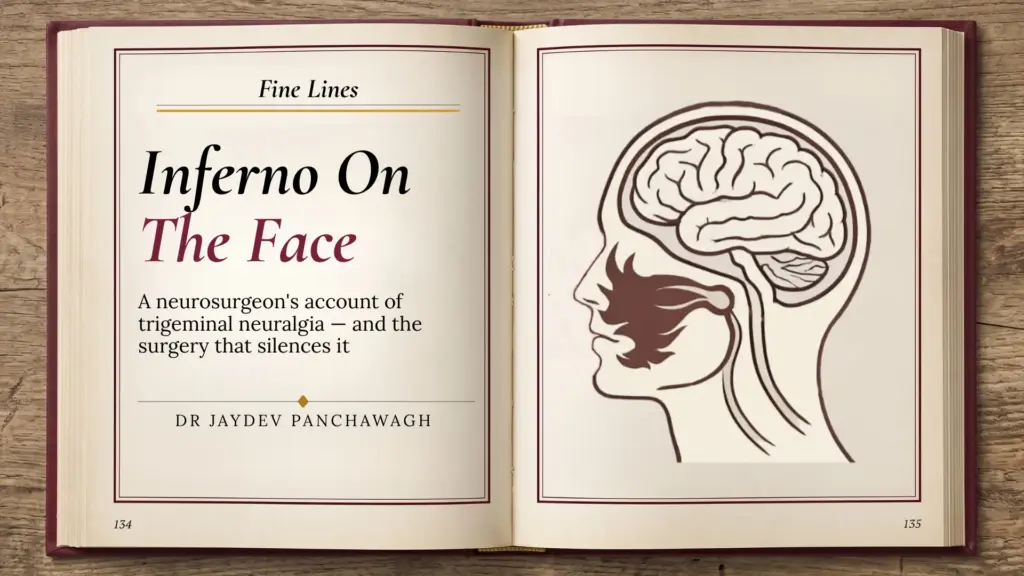
A neurosurgeon’s account of trigeminal neuralgia — the pain that has no mercy — and the surgery that can silences it permanently “Many neurologists consider it among the most severe pains the human nervous system can generate.Some have called it the suicide disease — not as metaphor,but because untreated cases carry a real risk of pushing patients toward self-harm.” — Dr Jaydev Panchawagh · Trigeminal Neuralgia Centre, Pune While operating on a patient with the extreme pain of trigeminal neuralgia, I turned the beam of the neuromicroscope deep into the lower part of the brain — onto the very structure called the pons. Under that cold, brilliant light, the trigeminal nerve came into view. The fifth cranial nerve. The great sensory highway of the face. Her trigeminal nerve was not the smooth, pearl-white cord it was supposed to be. It had been crushed flat. A blood vessel — large, unyielding, pulsing — had buried itself into the nerve’s most vulnerable segment: the root entry zone, where the protective myelin sheath is thinnest. The vessel had not merely rested against the nerve. Over the years, it had bored into it, and the nerve had frayed apart in response — its fibres separating like threads pulled from a torn cloth. Seventy-five to eighty times a minute, the artery pulsed. With each beat, a blow of a hammer on the nerve. For years. Day after day, month after month, year after year. The nerve looked like a crushed ribbon. “This degree of damage need not have happened. If surgery had been performed earlier, this patient would not have suffered so long.” The delay, in case after case, has the same cause: the patient simply did not know. The family did not know. Often enough, even the treating doctors did not know. Trigeminal neuralgia has spent too long entangled in a web of misunderstanding. Nivedita Bhatnagar: An Architect Without Words Nivedita Bhatnagar (name changed) — an architect from Delhi. Deeply capable. Perceptive. And extraordinarily eloquent about her own pain. When she first came to our centre, she could only gesture. Even the small act of opening her mouth to form words triggered a bolt of electricity through the right side of her face. The simple daily architecture of language had become a minefield. “It truly began in January 2004. A sudden, sharp pain would start in the upper right gum and radiate into the right cheek. The pain was like an electric shock. Instant. Without warning. Brushing my teeth, if the brush touched the right gum — or while chewing on that side — these were enough to trigger it. An unbearable, shattering jolt.” She went first to a dentist, as almost every patient with this condition does. The upper right molar received a root canal. The pain not only persisted — it grew. A neurologist recognised a nerve problem and prescribed carbamazepine. “The medicine helped while it worked. But it made me drowsy. I began forgetting things. As the dose increased, I started losing my balance when I walked. I thought: if one nerve in one small location is the problem, why am I numbing every nerve in my body? That is not treatment. That is suppression.” She was exactly right. The drugs do not address the cause. They address the signal. And as the underlying compression worsens, the signal grows louder, the dose must rise, and the side effects multiply. The person diminishes. The Architecture of Fear It is not the pain alone that destroys a life — it is the anticipation of pain. Between attacks, the person lives in a state of suspended dread. Will it happen now? This question follows every meal, every conversation, every walk in the wind. The face becomes a danger zone. People stop speaking in full sentences, stop eating certain foods, stop going outside in cold weather, stop socialising. Sustained pain remaps the brain. It alters threat perception, attention, sleep, and mood. A person with long-standing trigeminal neuralgia has not only a damaged nerve — they have a nervous system that has been reorganised by years of crisis. What Is Trigeminal Neuralgia — The Science The trigeminal nerve is the fifth and largest of the twelve cranial nerves, with three branches covering the forehead and eye, the cheek and upper jaw, and the lower jaw and chin. In trigeminal neuralgia, something goes wrong at precisely the point where the nerve enters the pons. An adjacent blood vessel — most often the superior cerebellar artery — subjects the nerve to constant mechanical pressure. As we age, arteries lengthen and grow more tortuous. A vessel that once ran parallel to the nerve begins to loop toward it. It makes contact. It presses. It pulses — seventy, eighty, a hundred times a minute. Over years, this pulsatile trauma erodes the myelin sheath. When the myelin is gone, bare axons are exposed. The trigeminal nerve begins to misfire in response to the lightest stimuli: a brushstroke, a breath of cool air, a sip of water. “Some have called it the suicide disease — not as metaphor, but because untreated cases carry a real risk of pushing patients toward self-harm. The pain is that severe and that relentless.” The Inadequacy of Burning the Nerve For most of the last century, treatments have been aimed at the nerve itself — not the offending vessel. Alcohol injections. Radiofrequency ablation. Glycerol injections. Stereotactic radiosurgery. But this logic misses the point entirely. The nerve is not malfunctioning because it is inherently defective. It is malfunctioning because it is being compressed. Ablating the nerve addresses the symptom while leaving the cause in place. As the vessel continues to press, the disease continues to advance. Each repetition carries risks — including permanent facial numbness, or the development of anesthesia dolorosa, in which the face is numb but burning simultaneously. Peter Jannetta and the Surgery That Changes Everything In the 1960s, an American neurosurgeon named Peter Jannetta changed the course of this disease permanently. His premise was
